- This topic is empty.
-
AuthorPosts
-
2026-10-26 at 5:32 pm #13495
Electric meter boxes are essential components of residential, commercial, and industrial electrical systems. They protect electricity meters, electrical connections, and related components while providing a suitable enclosure for metering equipment. However, not every electric meter box is designed for the same environment. Indoor and outdoor installations present different challenges, making it important to select an enclosure that meets the specific requirements of its intended location.
Indoor electric meter boxes are generally installed in controlled environments where direct exposure to rain, sunlight, and extreme weather is limited. Outdoor electric meter boxes, by contrast, must withstand changing temperatures, moisture, ultraviolet radiation, dust, and other environmental factors. These differences influence material selection, enclosure structure, sealing design, durability, and maintenance requirements.
Understanding the differences between indoor vs. outdoor electric meter boxes helps contractors, electrical engineers, utility companies, and equipment buyers make informed purchasing decisions. This guide explores their main differences, explains how to choose the right enclosure, and highlights the factors that matter when sourcing electric meter boxes for different applications.
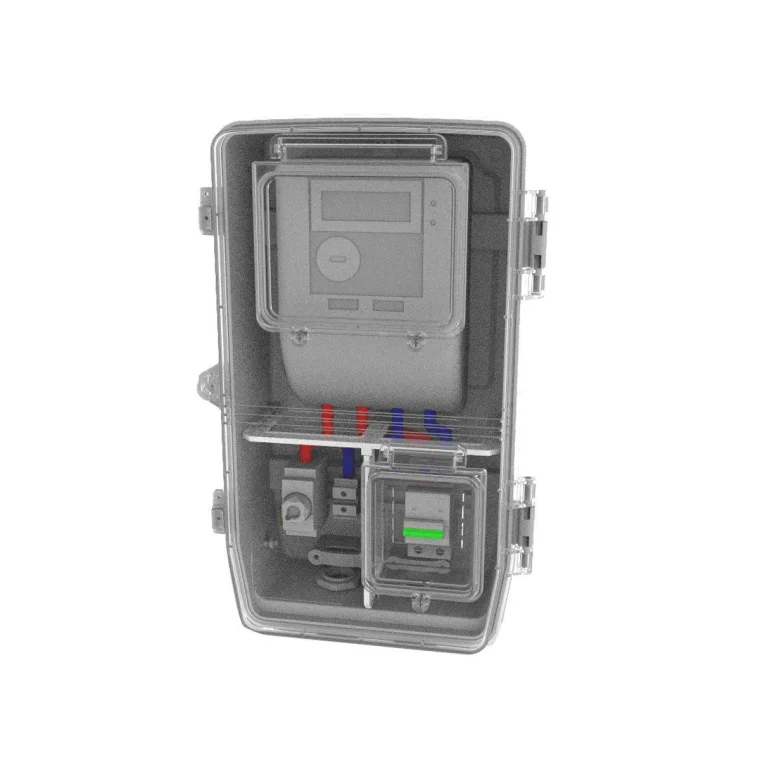
1. What Are Indoor Electric Meter Boxes?
Indoor electric meter boxes are enclosures designed to house electricity meters and associated electrical components inside buildings or other sheltered locations. They are commonly found in residential properties, apartment buildings, commercial facilities, and industrial premises.
Because these enclosures are installed in relatively protected environments, their design can focus on electrical safety, accessibility, installation convenience, and compatibility with the surrounding electrical system.
Key Characteristics of Indoor Electric Meter Boxes
Protection from accidental contact
An indoor electric meter box helps prevent unauthorized or accidental contact with electrical terminals and other components. Its enclosure structure should provide suitable protection for the intended installation and comply with the applicable electrical safety requirements.
Compact and practical design
Indoor installations may have limited wall space or designated electrical equipment areas. Compact dimensions, suitable mounting arrangements, and efficient use of internal space can therefore be important selection factors.
Convenient access for inspection
Electricity meters may need to be read, inspected, or replaced periodically. An indoor meter box should provide suitable access while maintaining the required level of protection against accidental contact and unauthorized interference.
Flexible material options
Indoor electric meter boxes may be manufactured from materials such as ABS, other engineering plastics, SMC composites, or metal. The appropriate choice depends on the required mechanical strength, electrical insulation, fire performance, installation conditions, and applicable standards.
Typical Applications
Indoor electric meter boxes are commonly used in:
-
Residential houses and apartment buildings.
-
Commercial offices and retail premises.
-
Indoor electrical distribution rooms.
-
Industrial facilities with designated metering areas.
-
Utility metering installations located inside protected buildings.
Indoor installation does not automatically eliminate environmental risks. Areas with high humidity, condensation, dust, corrosive substances, or elevated temperatures may require a more robust enclosure than a typical indoor environment.
2. What Are Outdoor Electric Meter Boxes?
Outdoor electric meter boxes are designed for electricity metering installations exposed to external environmental conditions. They may be mounted on exterior walls, placed in utility cabinets, or installed at other designated outdoor locations.
Compared with indoor enclosures, outdoor electric meter boxes generally require more attention to weather resistance, sealing, material durability, and temperature performance.
Key Characteristics of Outdoor Electric Meter Boxes
Resistance to rain and moisture
Rainwater can enter an enclosure through poorly designed joints, cable entries, door gaps, or damaged seals. Outdoor meter boxes therefore need an appropriate enclosure structure and sealing system to help prevent water ingress.
Protection against sunlight
Prolonged ultraviolet exposure can cause some enclosure materials to fade, become brittle, or lose mechanical performance. Outdoor electric meter boxes should use materials and surface treatments suitable for the expected level of sunlight exposure.
Performance under temperature changes
Outdoor enclosures may experience substantial temperature fluctuations between day and night or across seasons. Their materials, seals, hinges, and fastening components must remain suitable for the expected operating temperature range.
Durability in exposed locations
An outdoor meter box may be subjected to wind-driven rain, airborne dust, accidental impacts, and other environmental stresses. Its structural design should provide adequate protection throughout the intended service life.
Typical Applications
Outdoor electric meter boxes are frequently used for:
-
Residential electricity meters mounted on exterior walls.
-
Apartment complexes with external metering installations.
-
Commercial buildings with outdoor utility connections.
-
Industrial sites with exposed metering equipment.
-
Utility infrastructure in locations without a dedicated indoor metering room.
The exact requirements depend on the installation location, local electrical regulations, and the level of environmental exposure.
3. Indoor vs. Outdoor Electric Meter Boxes: A Direct Comparison
Although indoor and outdoor electric meter boxes serve the same basic purpose, their design priorities can differ significantly.
Comparison factor
Indoor electric meter boxes
Outdoor electric meter boxes
Installation environment
Inside buildings or sheltered spaces
Exposed to outdoor conditions
Water protection
Based on indoor moisture and cleaning risks
Requires protection appropriate to rain and water exposure
Dust protection
Depends on the installation environment
Often important in exposed or dusty locations
UV resistance
Usually less critical without direct sunlight
Important when exposed to prolonged sunlight
Temperature variation
Often relatively moderate
May involve wider temperature fluctuations
Material selection
Based on safety, strength, cost, and local conditions
Also considers weathering and long-term outdoor exposure
Sealing design
Depends on required protection
Often requires more comprehensive weather sealing
Maintenance concerns
Dust, accidental damage, access, and indoor humidity
Weathering, seal deterioration, condensation, and environmental damage
Typical design priorities
Compactness, accessibility, and electrical safety
Environmental protection, durability, and electrical safety
These distinctions are general guidelines rather than fixed rules. An indoor electrical room may require substantial protection against dust or moisture, while a sheltered outdoor installation may face less exposure than an enclosure mounted directly on an exterior wall.
The correct electric meter box should therefore be selected according to actual environmental conditions and applicable technical requirements, rather than installation location alone.
4. Material Selection: Which Materials Are Suitable?
Material selection is one of the most important considerations when choosing electric meter boxes. Different materials offer different combinations of mechanical strength, insulation, weight, weather resistance, and manufacturing flexibility.
ABS Electric Meter Boxes
ABS, or Acrylonitrile Butadiene Styrene, is a thermoplastic commonly used in electrical housings and molded enclosures.
ABS electric meter boxes can offer good impact resistance, relatively low weight, and a smooth surface finish. Injection molding also supports the production of complex shapes, mounting features, and consistent dimensions.
These characteristics make ABS a practical option for many indoor electric meter boxes, particularly where compact designs and manufacturing efficiency are important.
ABS can also be suitable for outdoor applications when the selected grade and finished enclosure have been designed and tested for the intended environment. Standard ABS should not automatically be assumed to provide adequate long-term UV resistance.
SMC Electric Meter Boxes
SMC, or Sheet Molding Compound, is a glass-fiber-reinforced thermoset composite commonly used in electrical enclosures.
SMC electric meter boxes can provide good structural rigidity, mechanical strength, and electrical insulation. Properly formulated SMC compounds may also offer useful resistance to moisture, corrosion, and outdoor exposure.
These characteristics make SMC worth considering for outdoor metering installations and applications requiring a rigid, durable enclosure.
However, the performance of an SMC electric meter box still depends on the resin formulation, reinforcement, manufacturing quality, and finished-product design.
Metal Electric Meter Boxes
Metal enclosures are another option for indoor and outdoor metering installations. Depending on the metal and surface treatment, they can provide good mechanical protection and structural strength.
However, corrosion protection, electrical bonding, grounding, and insulation requirements must be considered carefully. Metal enclosures may require coatings or other protective measures in corrosive or humid environments.
5. Weather Resistance and Ingress Protection
Weather resistance is one of the clearest differences between indoor and outdoor electric meter boxes. Outdoor enclosures need to protect their contents against environmental exposure without compromising electrical safety.
Understanding IP Ratings
Ingress Protection (IP) ratings classify the protection an enclosure provides against access to hazardous parts, solid foreign objects, and water under specified test conditions.
An IP rating contains two digits. The first relates to protection against solid objects and access, while the second relates to protection against water.
For example, IP54 indicates a defined level of protection against dust and splashing water, while IP65 indicates dust-tight construction and protection against water jets under the applicable test conditions.
These ratings do not mean that an enclosure is suitable for every outdoor environment. They also do not establish resistance to ultraviolet radiation, corrosion, mechanical impact, or every form of water exposure.
The appropriate rating depends on the installation location and the requirements of the relevant electrical regulations.
Why Sealing Design Matters
The IP performance of an electric meter box depends on the complete enclosure, not just its material.
Important design elements include:
-
Door gaskets and sealing materials.
-
Joint design between enclosure sections.
-
Cable glands and conduit entry points.
-
Cover retention and fastening mechanisms.
-
Openings for ventilation or drainage.
-
Installation orientation and mounting arrangements.
A high-quality enclosure material cannot compensate for poorly designed cable entries or damaged seals.
For outdoor electric meter boxes, buyers should request applicable test documentation for the complete assembled product. Where the enclosure is intended for a particularly demanding environment, additional verification may be necessary.
6. Temperature Resistance and Condensation Control
Temperature management is another important consideration when selecting an electric meter box.
Indoor installations often experience more stable temperatures, particularly in climate-controlled buildings. However, enclosed utility rooms and industrial facilities may still become hot because of electrical equipment, restricted ventilation, or nearby machinery.
Outdoor installations can experience direct solar heating, cold weather, and rapid changes in ambient temperature. These conditions may affect enclosure dimensions, seal performance, and the mechanical properties of some materials.
Thermal Performance
When selecting an outdoor electric meter box, buyers should consider both ambient temperature and the temperature inside the enclosure.
Sunlight can raise the surface temperature above the surrounding air temperature. Electrical components can also generate heat during operation, potentially increasing the internal temperature further.
Material temperature ratings should therefore be evaluated alongside the electrical equipment's operating requirements.
Condensation Risks
Condensation can occur when warm, humid air inside an enclosure cools and moisture forms on internal surfaces. This can happen in both indoor and outdoor installations, particularly where temperatures fluctuate significantly.
Moisture inside an electric meter box may contribute to corrosion of metal terminals, deterioration of components, or electrical reliability problems.
Depending on the application, condensation management may involve suitable enclosure placement, appropriate ventilation, drainage arrangements, or other engineered measures. Any ventilation opening must be designed so that it does not compromise the required ingress protection.
For outdoor installations, the combined effects of temperature variation, moisture, and sunlight should be considered during enclosure design and material selection.
7. Installation Requirements and Accessibility
The installation requirements for indoor and outdoor electric meter boxes can also differ.
Indoor Installation Considerations
Indoor electric meter boxes are often installed in designated electrical areas or on interior walls. Buyers and installers should consider the available space, mounting surface, cable routing, and accessibility for authorized inspection.
The enclosure should not obstruct walkways or interfere with other building equipment. Its installation height and access arrangements must follow local regulations and utility requirements.
In multi-unit buildings, the design may also need to accommodate several meters while allowing authorized personnel to identify and access each unit.
Outdoor Installation Considerations
Outdoor electric meter boxes require additional attention to mounting conditions and environmental exposure.
The enclosure should be installed on a suitable support structure and positioned according to the relevant utility and electrical requirements. Cable entries, fasteners, and seals must be compatible with the installation method.
Installers should also consider exposure to direct sunlight, wind-driven rain, accidental impact, and potential physical interference.
Where meter reading or maintenance is performed from outside a building, the enclosure should provide practical access without compromising security or environmental protection.
Electrical connections and installation work should be performed by qualified personnel in accordance with applicable local codes and utility requirements.
Conclusion
Indoor and outdoor electric meter boxes serve the same fundamental purpose, but their design requirements differ according to the installation environment. Indoor enclosures typically prioritize electrical safety, convenient access, and practical installation, while outdoor enclosures must also address weather exposure, UV radiation, temperature fluctuations, and moisture protection. Selecting the right product requires careful consideration of material properties, sealing design, applicable standards, and long-term operating conditions.
For projects requiring customized electric meter boxes, manufacturing expertise is equally important. Quansheng brings over 20 years of experience in complex plastic and metal structural parts, mold manufacturing, hardware accessories, stamping parts, and complete assemblies. With OEM and ODM services supported by an in-house R&D center, mold workshop, injection molding workshop, and sheet metal workshop, Quansheng provides manufacturing capabilities that support the development and production of electric meter boxes tailored to different product designs and application requirements.
http://www.quan-sheng.net
quan-sheng -
-
AuthorPosts

- You must be logged in to reply to this topic.