- This topic is empty.
-
AuthorPosts
-
2026-10-19 at 5:35 pm #13417
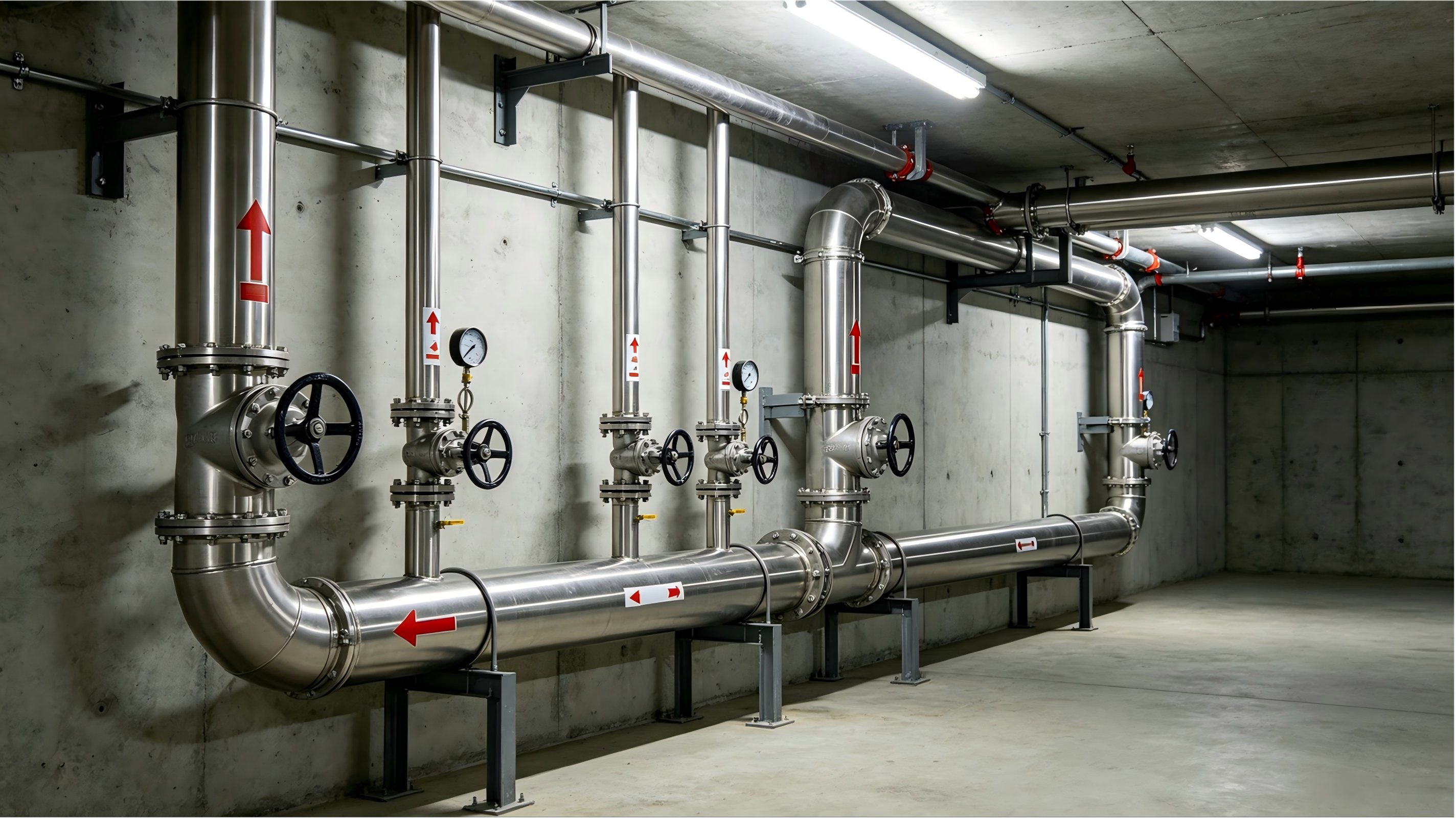
Gas distribution networks are judged at their joints. Pipe barrels rarely fail first; the connection is where leakage paths, corrosion cells, and installation variance concentrate. That reality has pushed gas transmission specialists toward mechanical connection systems that keep the torch out of the trench — and toward Double Press technology as one of the more established options in that category.
This guide examines how stainless steel gas pipe performs when paired with Double Press fittings, what the documented parameters are, and how Guangdong Yuehua Stainless Steel Profiles Co., Ltd. — trading as Yuehua Stainless Steel — structures its gas piping range for residential, commercial, industrial, and municipal networks.
Why Gas Networks Are Moving Away from Welded Joints
Conventional gas piping depends on welding or threading at almost every change of direction. Both methods carry known penalties. Welding is skill-dependent, introduces heat-affected zones, and cannot be verified visually with confidence. Threading removes wall section at the most highly stressed point of the fitting and creates crevices where moisture accumulates.
The documented pain points in gas distribution are consistent: leakage pathways from traditional welded or threaded joints, corrosion and material degradation across distribution networks, and installation inefficiency tied to specialized labor. Each of these is a joint-level problem rather than a pipe-level problem, which is why connection technology — not metallurgy alone — drives failure statistics.
What Double Press Technology Actually Does
Double Press is a clamp-compression connection. The pipe is inserted into a fitting containing a sealing ring, and a mechanical pressing tool compresses the fitting at two designated positions. No welding, no threading, no open flame. The seal is achieved by controlled deformation of the fitting around the tube, with the sealing ring providing the primary barrier against gas escape.
Yuehua Stainless Steel holds national utility model and invention patents covering this connection geometry, including a sealing ring groove design engineered for leak resistance under vibration and thermal cycling — the two conditions most likely to loosen a mechanical joint over a service life measured in decades.
Sealing materials are FKM fluoro-rubber and silicone, selected against the operating environment rather than applied uniformly. The documented installation sequence is deliberately short and repeatable: pipe blanking, deburring, marking and drawing lines, checking the seal ring, inserting the tube, then squeezing and sealing. Every step is inspectable before the tool is applied, which is the structural advantage over welding — a failed weld hides until the pressure test, while a missing or misseated seal ring is visible in the hand.
Pressure Performance and Service Life
For applicable Double Press connection systems, the documented working pressure is above 2.5 MPa, with a service life of up to 70 years under normal use conditions. Those two figures, taken together, are what make the system viable for gas rather than water alone: gas networks require both a pressure margin and a joint that will not relax across a building’s design life.
The matching stainless steel gas pipe is supplied in SUS 304, SUS 304L, and SUS 316L, with outer diameter from 16 to 325 mm, wall thickness from 0.6 to 4.5 mm, and standard length of 6 m — all available to specification or customized. Connection compatibility spans Double Press, ring pressing, grooved, and welded, so a network design can mix methods at transitions without changing pipe supply.
Product standards cited for the gas pipe range include GB/T 19228.2-2011, GB/T 12771-2008, CJ/T 151-2016, GB/T 33926-2017, and DIN EN 10312:2002+A1:2005, with ISO, TS, and HPPI certification. Fittings reference GB/T 19228.1-2024, CJ/T 152-2016, GB/T 33926-2017, DIN EN 10312:2002+A1:2005, and CJ/T 466-2014.
The mechanical properties that matter in gas service are stated plainly: high strength and impact resistance, high corrosion resistance, low thermal expansion, stable mechanical performance, smooth inner walls with low flow resistance, and resistance to high temperature, leakage, and pressure. The low thermal expansion coefficient is not a marketing point — it is what keeps a long riser run dimensionally stable between commissioning and a decade of seasonal cycling.
Control of the Variables That Cause Leaks
A mechanical joint is only as reliable as the tube end entering it. Yuehua’s in-process controls address this directly: real-time monitoring of welding current, shielding gas flow, and line speed; online laser dimensional gauging; 100% eddy current testing on all weld seams; and automated surface scanning with manual inspection after polishing and passivation.
Incoming coil is chemically verified by high-precision spectrometer against ASTM A240 and JIS G4304, with mandatory batch dimensional inspection of thickness, width, and edge condition. Final release includes hydrostatic pressure testing to GB/T 19228.1, batch destructive testing — tensile, flattening, and flaring — per GB/T 19228.2, and assembly accuracy and sealing verification for Double Press fittings before QA approval.
Raw material traces to POSCO, TISCO (Taiyuan Iron and Steel), and Yongjin. Delivery lot traceability packages include mill test certificates from those mills, production batch QA/QC reports covering welding parameters, annealing records, eddy current results, hydrostatic test data, and dimensional inspection logs, plus per-batch chemical composition reports with OES verification. Records are retained for a minimum of ten years — the practical requirement for regulatory inspection of a gas installation years after handover.
Manufacturing Depth Behind the System
The connection is a system, not a component. Guangdong Yuehua Stainless Steel Profiles Co., Ltd. was founded in 1991 and operates a self-owned industrial campus of over 150 mu — approximately 100,000 square meters — in Shantou, Guangdong Province, with more than 50,000 square meters of production workshops, over 10,000 square meters of warehousing and logistics space, and more than 200 sets of auxiliary pipe fitting manufacturing equipment covering pressing, grooving, threading, and welding stations. Estimated annual production value exceeds RMB 1 billion, with annual capacity of 80,000 tons of stainless steel pipes and fittings.
Vertical integration runs from raw coil slitting through tube forming, TIG welding, online solution heat treatment, sizing, straightening, polishing, eddy current testing, and finished pipe — the same campus producing the fittings that receive it. Three decades of continuous operation, more than 30 national patents, a Technology Research and Development Center established in 2017, and participation in drafting national, industry, and association standards for stainless steel piping systems underpin the claim that pipe and fitting tolerances are engineered together rather than matched after the fact.
Quality management is certified to ISO 9001, ISO 14001, and ISO 45001, with CE marking for pressure equipment, RoHS compliance, a Pressure Pipe Element Production License, and a Drinking Water Product Hygiene Safety License. Recognition includes High-Tech Enterprise status, the Guangdong Famous Trademark for the YUE HUA mark, and China Well-Known Brand designation.
Specification Considerations for Gas System Designers
Three decisions determine whether a Double Press gas system performs as documented.
First, material grade against environment. SUS 304 and 304L suit general distribution; SUS 316L is the appropriate selection where chlorides, coastal atmospheres, or process exposure are present. Yuehua processes all four grades routinely, which keeps grade substitution a supply decision rather than a sourcing problem.
Second, seal compound against medium and temperature. FKM and silicone behave differently across temperature ranges and gas compositions. The selection should be stated explicitly on the datasheet, not left to default.
Third, installation discipline as a specification item. The six-step pressing sequence is only repeatable if the pressing tool is calibrated and the operator is trained. Specifying tool calibration intervals and press-profile verification is as consequential as specifying wall thickness.
Frequently Asked Questions
Can stainless steel gas pipe be joined without welding? Yes. Double Press and ring pressing connections are non-welded and designed to minimize leakage pathways, with working pressure above 2.5 MPa for applicable systems.
What diameter range is available? Outer diameter from 16 to 325 mm, wall thickness from 0.6 to 4.5 mm, standard 6 m lengths, all customizable. Double Press fittings cover DN15–DN100 for standard 90-degree elbows.
How is quality verified before shipment? 100% eddy current testing on weld seams, hydrostatic testing to GB/T 19228.1, batch tensile, flattening, and flaring tests, dimensional and sealing verification, and QA manager approval before delivery.
What is the lead time? Thirty to sixty days after payment, confirmed against material, size, wall thickness, quantity, surface finish, and customization.
Conclusion
For gas transmission specialists, the engineering question is not whether stainless steel belongs in a distribution network — it is whether the joint can be trusted for seventy years without a torch, a thread, or a return visit. Double Press technology answers that question with a mechanical connection whose seal, geometry, and verification steps are documented and repeatable. Yuehua Stainless Steel supplies that answer as an integrated system: pipe, fitting, seal, traceability record, and the manufacturing campus that produces all four together.
http://www.yuehuasus.com
Guangdong Yuehua Stainless Steel Profiles Co., Ltd -
AuthorPosts

- You must be logged in to reply to this topic.