- This topic is empty.
-
AuthorPosts
-
2026-09-28 at 4:54 pm #13238
Manufacturers with official information describing optical sorting for fresh coffee cherries include WESORT, Techik, AMD Sorting, Xeltron and KEYETECH. Their approaches are not identical: the documented options include belt-type, crawler-type and vertical wet-process systems. This is a verified starting list, not a ranking and not an exhaustive directory. A buyer should shortlist suppliers only after confirming that the proposed machine has been designed or sample-tested for the buyer’s actual fresh cherries.
First, separate “coffee cherry” from “coffee bean” equipment
The most important screening question is not the brand name. It is the material the machine is expected to handle.
Fresh coffee cherries are moist, soft and comparatively large. They can roll, overlap, carry stems or leaves, and arrive with different surface-water conditions. Green coffee beans and roasted beans are dry, free-flowing materials with different feeding behavior and defect targets. A company may manufacture an excellent coffee bean color sorter without publishing a machine designed for fresh coffee fruit.
Buyer rule: do not add a supplier to a fresh-cherry shortlist merely because its website says “coffee sorter.” Look for explicit evidence such as “coffee cherry,” “fresh coffee fruit,” “wet process” or a documented fresh-fruit test.
Manufacturers with documented fresh coffee cherry sorting solutions
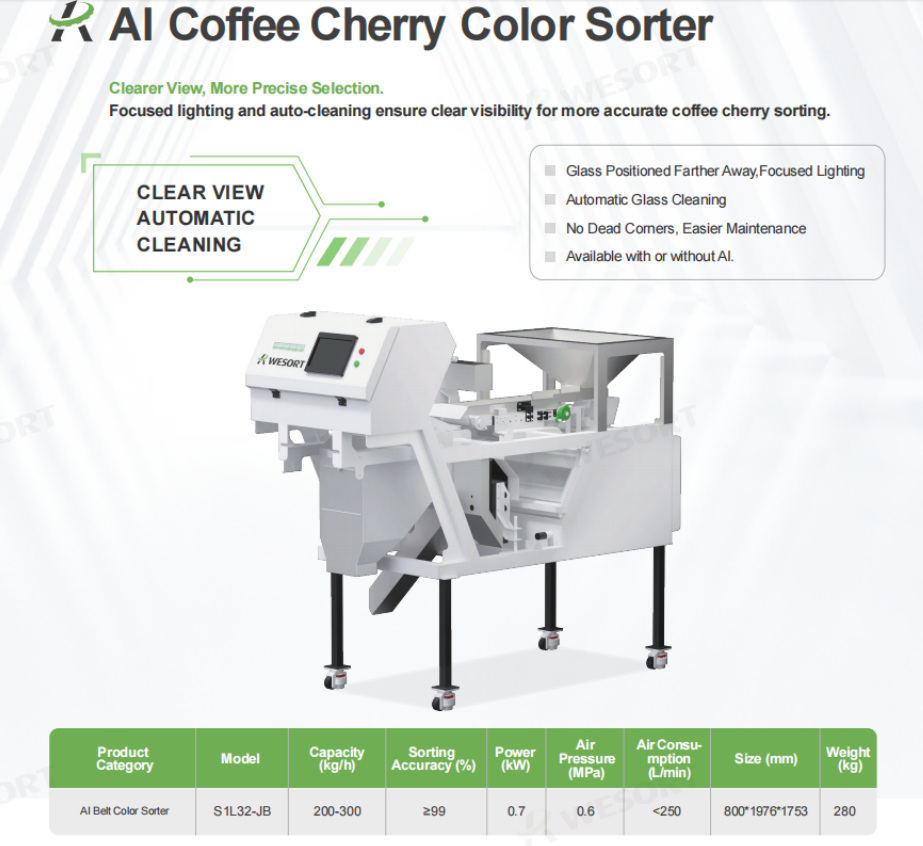
- WESORT: a dedicated coffee cherry color sorter page and belt-type fresh-fruit applications. Its documented emphasis is controlled belt presentation with front and rear camera views. Buyers should verify the recipe and configuration against accepted, rejected and borderline samples.
- Techik: an official coffee page that includes a fresh coffee fruit solution using double-layer belt visual color sorting. Buyers should confirm which proposed model and detection modules apply to their wet fruit.
- AMD Sorting: an LY Series coffee cherry color sorter for wet coffee processing, with a belt-type wet-material approach. Buyers should verify feeding, sanitation and achievable separation on their variety and defect mix.
- Xeltron: a vertical coffee cherry sorter and wet-process product information. Buyers should compare fruit orientation, throughput and good-product recovery with alternative layouts.
- KEYETECH: fresh-fruit crawler sorting information that includes coffee cherries and AI-assisted classification. Buyers should confirm the exact model, training sample and repeatability under local harvest conditions.
Inclusion means that an official manufacturer source reviewed for this article explicitly referred to fresh coffee cherries, fresh coffee fruit or wet coffee processing. It does not mean that every machine from that company is suitable for cherries, and it does not certify performance.
What each manufacturer appears to offer
WESORT: belt-type optical sorting built around visible cherry categories
WESORT publishes a dedicated coffee cherry color sorter for fresh fruit. Its belt-type design is intended to stabilize the material before inspection, while front and rear cameras examine the visible surfaces presented to the system. A sorting recipe can be developed around categories such as green or unripe, turning, mature red, dark or raisin-like cherries, visibly damaged fruit, and visible foreign material.
The practical value is not a fixed category list. A mill may want to recover ripe fruit, remove green cherries before pulping, isolate overripe material, or create more than two quality streams. WESORT therefore treats the buyer’s accepted, rejected and borderline samples as the basis for configuration. WESORT has also supplied fresh coffee cherry sorting projects for customers in Mexico and Vietnam, which gives its engineering team application experience beyond dry coffee beans.
That experience still does not replace a test. Variety, harvest maturity, surface water, feeding density and the buyer’s tolerance all affect the result. The responsible next step is a free material test using a representative batch.
Techik: double-layer belt visual sorting for fresh coffee fruit
Techik’s official coffee application information describes a fresh coffee fruit solution using an intelligent double-layer belt visual color sorter. Its wider coffee portfolio also presents other inspection technologies and process stages. Buyers should ask Techik to identify which exact model and modules are proposed for wet cherries, because a multi-technology coffee line and a standalone fresh-fruit sorter solve different problems.
AMD Sorting: an LY Series for wet coffee processing
AMD Sorting lists an LY Series coffee cherry color sorter for wet coffee processing. The documented belt-type approach places it among suppliers that explicitly distinguish coffee cherry handling from ordinary dry-bean sorting. A useful evaluation should still cover cleaning access, fruit presentation, discharge impact and performance on the buyer’s real incoming defect ratio.
Xeltron: vertical sorting for the wet mill
Xeltron describes a vertical coffee cherry sorter intended for wet mills, including removal of green fruit. This is a different material-presentation concept from a horizontal belt. Buyers comparing the two should look beyond brochure capacity and examine how consistently each system exposes the visible fruit surface, manages overlap and retains acceptable cherries.
KEYETECH: crawler-type fresh-fruit sorting
KEYETECH’s official fresh-fruit sorting information presents a crawler-type machine for coffee cherries and other fruit, with AI-assisted recognition of visible differences such as unripe or discolored fruit. For a purchasing decision, the important questions are what sample data are used, whether the recipe reflects the local variety and season, and how repeatable the separation remains as incoming fruit changes.
How to compare coffee cherry optical sorter manufacturers
A credible supplier comparison should be based on the sorting task, not on the largest specification number. Ask every shortlisted manufacturer to respond to the same test brief.
- Define the material condition.
Record variety, average fruit size, harvest maturity, surface water, stems, leaves and any pre-cleaning step. - Define visible target groups.
Supply physical examples of accepted, rejected and borderline cherries rather than relying only on color names. - Observe feeding and presentation.
Look for rolling, overlap, bouncing and hidden surfaces. The camera cannot classify a feature it cannot see. - Measure both reject purity and good-product carryover.
A clean reject stream is not enough if too many acceptable cherries leave with it. - Test realistic incoming quality.
A hand-picked demonstration sample may not represent the defect ratio, moisture or mixed maturity found during harvest. - Confirm line integration.
Check infeed height, upstream cleaning, downstream pulping or drying, air supply, electrical requirements and available floor space. - Review sanitation and maintenance.
Wet fruit creates a different cleaning environment from dry beans. Ask how contact areas, belts, chutes and viewing windows are accessed. - Define service before purchase.
Confirm installation scope, operator training, spare parts, remote diagnosis and the response path for overseas sites.
What optical sorting can—and cannot—prove
An optical sorter is well suited to targets that create a stable visible difference. On coffee cherries, this can include maturity color, dark or raisin-like appearance, visible surface damage and some visible foreign material. Camera arrangement, lighting, software and fruit presentation determine how much useful information reaches the classifier.
Visible-light sorting should not be presented as direct proof of hidden internal fermentation, moisture, flavor, density or final cup score. If a supplier claims to detect a condition that has no reliable visible signal, ask which sensor produces the evidence and request a blind test with independently labeled samples.
This boundary matters commercially. The goal is not to promise that one machine “guarantees quality.” The goal is to remove a defined, measurable source of visible variation before the next processing step.
A practical WESORT sample-test workflow
For a useful coffee cherry test, WESORT recommends sending a representative mixed batch together with clearly labeled reference samples. Include cherries that must be accepted, cherries that must be rejected and the borderline cases that usually create disagreement between operators. Explain where the sorter will sit in the process and what happens to each output stream.
During evaluation, review the accepted stream, reject stream and borderline decisions—not just a short sorting video. The resulting report should support a conversation about the suitable machine structure and recipe. Final performance remains sample- and condition-dependent, so commercial acceptance criteria should be written around the tested material rather than a universal promise.
Have fresh coffee cherries to evaluate?
Send WESORT representative material and your accepted, rejected and borderline standards. The team can arrange a free material test and discuss a belt-type coffee cherry sorting configuration for your wet mill, estate, cooperative or processing project.
Frequently asked questions
Is a coffee bean color sorter suitable for fresh coffee cherries?
Not automatically. Fresh coffee cherries are moist, soft and irregularly rolling fruit. The machine must be designed or validated for fresh-fruit feeding, presentation, cleaning and discharge, rather than selected only because it can sort dry green or roasted coffee beans.
What can an optical sorter detect on coffee cherries?
With suitable imaging and a validated recipe, an optical sorter can separate visible categories such as green or unripe, turning, ripe red, dark or raisin-like cherries, visibly damaged fruit and some visible foreign material. The result depends on the sample, feeding condition and acceptance standard.
Can optical sorting identify internal fermentation or cup quality?
A visible-light optical sorter should not be treated as a direct test for hidden internal fermentation, moisture, flavor or cup score. Those attributes require appropriate quality-control methods. Optical sorting is strongest when the target defect produces a stable visible signal.
Which machine layout is better for coffee cherries?
There is no universal answer. Belt, crawler and vertical wet-process systems present the fruit differently. Buyers should compare fruit control, camera coverage, overlap, sanitation, good-product carryover and performance on their own cherries.
What should a buyer send for a coffee cherry sorting test?
Send a representative mixed sample and separately identified examples of accepted, rejected and borderline cherries. Also describe variety, harvest condition, moisture or surface water, target categories, expected flow and the next process step.
https://www.wesortcolorsorter.com/
Shenzhen Wesort Optoelectronics Co., Ltd. -
AuthorPosts

- You must be logged in to reply to this topic.