- This topic is empty.
-
AuthorPosts
-
2026-11-04 at 7:26 pm #13652

Image Source: https://www.xuxiangtaimetal.com When US industrial buyers look for a contract metal manufacturer that can handle every stage of production under one roof, Qingdao Xuxiangtai is built for exactly that. From our manufacturing base in Qingdao, China, we serve American OEM and ODM buyers through six integrated processes, giving you a single accountable partner from drawing to delivery.
CNC machining delivers 5-axis milling and turning for tight-tolerance parts, so complex geometries and precise fits are machined in a single setup. Casting and forging cover die casting, sand casting, and silicasol investment casting, plus forging for shaped and high-strength components—matching the right process to each part’s structural and performance requirements. Sheet metal fabrication handles laser cutting, CNC bending, stamping, and structural welding for enclosures and frames, producing durable, accurately formed assemblies. Metal 3D printing builds complex internal geometries that traditional methods cannot achieve, enabling topological optimization and advanced alloy components. Surface treatment applies anodizing, powder coating, electroplating, and Dacromet for corrosion resistance, extending service life in demanding environments. Assembly completes final integration, so you receive finished, ready-to-install products.
Every process is build-to-print, manufactured strictly to your drawing standards. Dimensional inspection and material testing verify each order, backed by a full quality system that includes IATF 16949 certification and RoHS compliance. A defined workflow guides US buyers from drawing to delivery, with DFM review, spectral material analysis, and non-destructive testing reports available along the way.
With more than 20 years of export experience, a 26,200 m² production plant, and over 460 completed industrial custom manufacturing projects for more than 130 international clients, we understand what US industrial buyers need: consistent quality, clear communication, and reliable global delivery.
Buyers can send drawings for a custom quotation. MTC certificates are available on request.
Key Takeaways
- Qingdao Xuxiangtai provides six manufacturing processes under one roof, so you can get all your metal parts made by a single partner.
- Every order includes thorough quality checks and certifications to ensure your parts meet the highest standards.
- You can send your drawings for a free review and quote, making it easy to start your project.
The Six Manufacturing Processes in the Portfolio
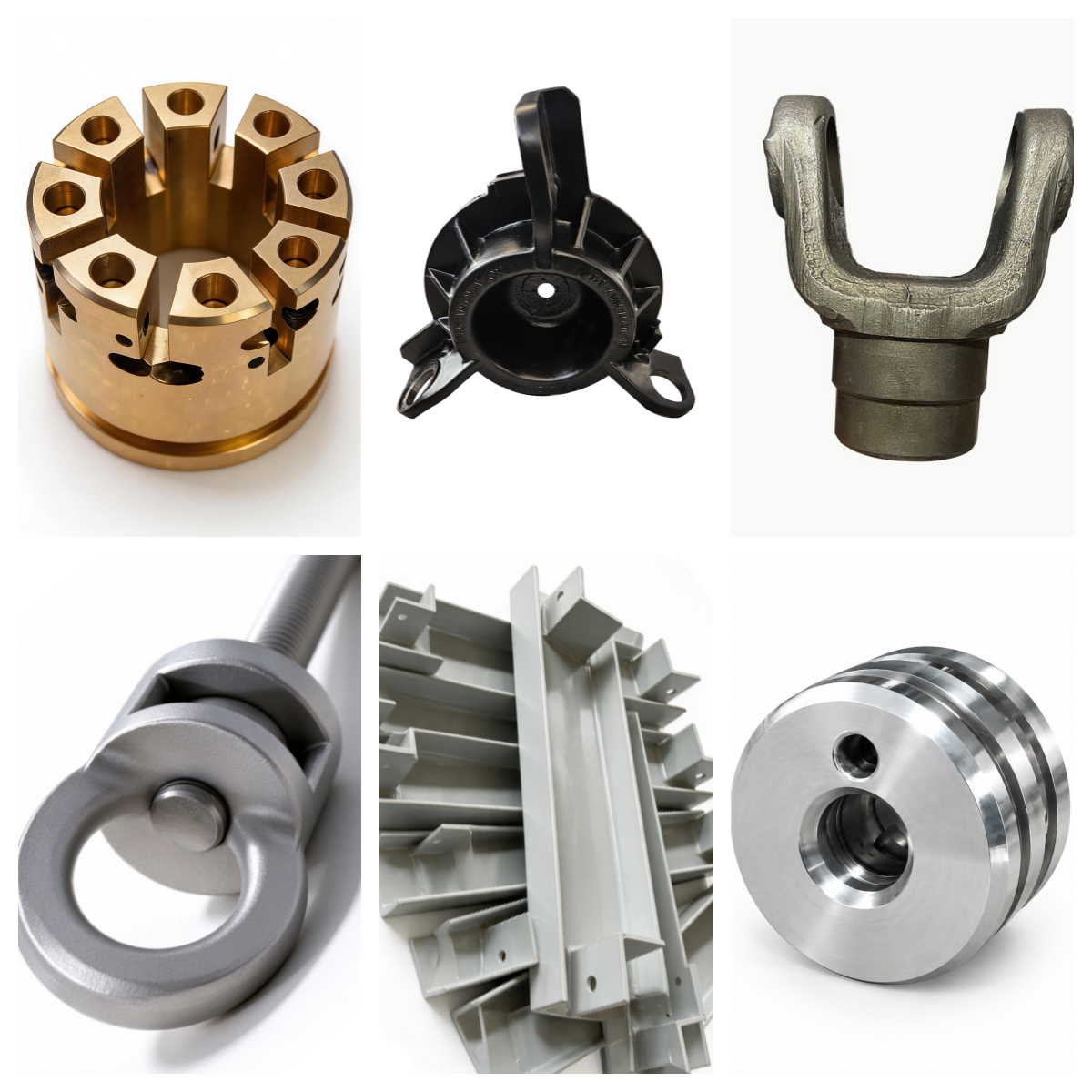
Qingdao Xuxiangtai runs six manufacturing processes under one quality system at its 26,200 m² plant in Jimo, Qingdao. Each process serves a distinct role in the production chain. Together they cover the full path from raw material to finished, tested, ready-to-install metal components. US industrial buyers can source a single part or a complete assembly without splitting the order across multiple vendors.
CNC Machining: 5-Axis Milling, Turning, and EDM
CNC machining forms the precision core of the portfolio. The shop runs 5-axis milling, CNC turning with composite machining, EDM, drilling, and tapping. These methods produce tight-tolerance parts for medical devices, aerospace systems, and automotive components.
Five-axis milling machines cut complex geometries in a single setup. Fathom Manufacturing notes that single-setup machining maintains datums throughout the process, which keeps tolerances, hole locations, and slot positions accurate. A 5-axis job typically runs as one setup, one continuous machining cycle, and one inspection. Three- and four-axis work often requires machining, inspection, resetting, and reinspection across multiple cycles. That difference adds labor hours and introduces stack-up error. Five-axis work removes both problems.
Turning handles cylindrical and multi-feature parts. Composite machining combines turning and milling in one operation for symmetrical components with cross-features. Typical milling tolerances reach ±0.001 in, and turning handles outer diameters up to 12 in, based on published contract machining benchmarks from JD Machine. Xuxiangtai commits tolerances per quote against the customer print, not as a blanket shop standard.
EDM adds a non-contact option for hard materials and intricate features. Wire EDM cuts conductive metals regardless of hardness, including Inconel, titanium, and superalloys. Compass Precision reports that wire EDM holds extremely tight tolerances without tool deflection, because the wire never touches the workpiece. Sinker EDM burns complex shapes into tool steel and tungsten. Methods Machine cites EDM tolerances as tight as ±0.0001 in with fine surface finishes that often skip secondary operations. The process generates no heat, pressure, or cutting force, so thin walls and delicate parts stay distortion-free.
EDM Advantage Practical Benefit for Buyers Cuts any conductive material regardless of hardness No material restrictions on tool steel, superalloys, or tungsten Non-contact cutting No tool deflection, no distortion on thin-wall parts Tolerances to ±0.0001 in Fits injection mold tools and fine-feature components Tight corner radii Internal corners that conventional cutters cannot reach Stacked-plate cutting Multiple workpieces per pass lowers unit cost Casting and Forging: Die, Sand, Investment, and Forged Parts
Casting and forging shape metal into near-final form. The portfolio includes die casting, sand casting, silicasol investment casting, and forging. Each process fits a different balance of volume, complexity, material, and strength.
Die casting presses molten aluminum and zinc into steel molds under high pressure. Amfas International describes the result as dense, dimensionally stable parts with tolerances often within ±0.05 mm. High-volume runs of automotive housings, electronics enclosures, and EV structural components suit this process. Thin walls and complex geometry come out of the mold close to net shape, which cuts secondary machining cost.
Sand casting uses gravity filling and lower tooling investment. It supports a wider material range, including cast iron and steel. Tolerances run looser and surfaces rougher than die casting, but sand casting handles very large or thick-section parts that other processes cannot. Xuxiangtai casts QT450 ductile iron machine bases this way. The graphite structure in ductile iron absorbs vibration, which keeps heavy machinery stable and quiet during operation.
Silicasol investment casting occupies the middle ground for volume and leads in geometric complexity. The process builds a ceramic shell around a wax pattern, which allows thin walls, internal passages, and intricate features. Niagara Investment Castings notes that investment casting achieves complex shapes with excellent surface finishes and high dimensional accuracy. The wax pattern also accepts design changes without new hard tooling. Stainless steel, carbon steel, and alloy steels all run through this process, which suits medical device parts and industrial sensor housings.
Forging works the metal in its solid state. Compressive force refines the grain structure and aligns grain flow along the part’s stress lines. QC Forge reports that forging closes internal voids, raises material density, and improves toughness under sudden impact and dynamic loads. Forged parts also accept post-forging heat treatment for hardness and ductility control. Aerospace, automotive, and heavy machinery load-bearing components rely on this combination of strength and fatigue resistance.
Process Best Material Fit Complexity and Precision Typical Parts Die casting Aluminum, zinc, magnesium Tight tolerances near ±0.05 mm, thin walls, high volume Automotive housings, electronics enclosures, EV structural parts Sand casting Cast iron, steel, ductile iron Large and thick-section parts, looser tolerances, machining follows Pump housings, machine bases, heavy industrial frames Investment casting Stainless steel, superalloys, carbon steel Thin walls, internal passages, smooth finish, small to medium parts Aerospace brackets, medical components, sensor housings Forging Carbon steel, alloy steel, aluminum High strength, refined grain flow, fatigue resistance Load-bearing shafts, connecting components, structural parts Sheet Metal Fabrication: Cutting, Bending, Stamping, and Welding
Sheet metal fabrication turns flat stock into enclosures, frames, brackets, and chassis. The shop runs laser cutting, CNC bending and spinning, stamping, and structural welding. These operations cover industrial automation cabinets, new energy equipment housings, and structural frames.
Laser cutting starts the flow. A focused beam cuts steel, aluminum, and brass sheets without contact or profile-specific tooling. JLCCNC reports dimensional accuracy around ±0.1 to 0.2 mm on suitable features, depending on material and thickness. The same CNC program cuts internal holes, angled slots, and curved profiles without punch or die changes. Small and medium batches avoid tooling setup time entirely. Heat-affected zones typically run 0.1 to 0.5 mm wide, which stays insignificant for structural and enclosure work.
CNC bending and spinning form the cut blanks. Multi-axis press brakes set flange angles and radii to the print. First-article inspection confirms formed dimensions before production continues. Stamping presses thin-metal parts at high speed for volume runs. Structural welding joins components into rigid frames and enclosures. TIG and MIG welding follow weld callouts on the drawing, and the shop raises questions when symbols or hardware locations lack clarity, which prevents floor delays.
Sheet metal carries design limits worth noting. Hollow and flat geometry restricts complexity compared with machining. Manual welding and assembly introduce more variability than CNC operations. Forming work-hardens the material and concentrates stress at bend lines. These limits stay manageable through print review at the quoting stage.
Metal 3D Printing for Complex Internal Structures
Metal 3D printing builds parts layer by layer from metal powder. The process removes the geometry limits of casting and machining. Internal cooling channels, conformal passages, and lattice structures become practical rather than theoretical.
The value shows up in three areas. First, internal channels route fluids and air through paths that traditional drilling cannot reach. 3D Hubs notes that channels larger than 8 mm work best with diamond or tear-drop cross sections, which avoid internal supports. Second, topology optimization removes weight while preserving strength. Engineers reshape a bracket or manifold around its actual load paths, and the printer builds the result directly. Third, skin-and-core structures process the outer skin and inner core at different laser powers and scan speeds. The same part then carries distinct material properties in different zones, which reduces print time and warping risk on large solid sections.
Xuxiangtai prints titanium and nickel-based high-temperature alloys. Aerospace and energy system designers use these materials for impellers and manifolds that face thermal stress. The process also cuts part count. A topologically optimized component can replace a multi-piece welded assembly, which removes joints and leak paths.
Internal cavities need drainage holes to clear unfused powder. Trapped powder adds weight and wastes expensive alloy that cannot be recovered. The DFM review catches this requirement before printing starts.
Surface Treatment: Anodizing, Powder Coating, and Plating
Surface treatment protects parts from corrosion and delivers the cosmetic finish buyers specify. The portfolio includes anodizing, powder coating, electroplating, and Dacromet coating. Each finish fits a different environment and performance target.
Anodizing grows an oxide layer on aluminum. Regular films run 5 to 12 μm thick, and hard anodizing reaches 25 to 70 μm. The layer improves corrosion resistance and surface wear resistance. Prolonged UV exposure degrades even hard anodizing, so outdoor parts pair the finish with a UV-blocking topcoat or extended sealing time.
Powder coating applies a polymer layer 60 to 70 μm thick. Adhesion runs strong, and corrosion resistance beats liquid paint. The thick film handles outdoor UV exposure and impact. Medical bed frames and industrial enclosures use this finish for both protection and appearance.
Electroplating deposits metal onto the part surface. Zinc plating outperforms nickel for corrosion resistance, and the zinc color order runs black, then yellow, then blue-white, then white. Plating also adds hardness and wear resistance for moving parts.
Dacromet coats parts in a zinc-aluminum flake layer 2 to 15 μm thick. The finish withstands hundreds of hours of salt spray testing and carries no hydrogen embrittlement risk. Marine, automotive underhood, and renewable energy hardware use Dacromet where salt and chemical exposure shorten part life. Wear resistance runs lower than plating, so the choice depends on the threat profile.
Finish Thickness Corrosion Strength Best Fit Anodizing 5–12 μm standard, 25–70 μm hard Good, needs UV topcoat outdoors Aluminum parts with wear and oxidation exposure Powder coating 60–70 μm Strong, handles outdoor UV Enclosures, frames, cosmetic surfaces Electroplating (zinc) Varies by spec Good, color-dependent ranking Parts needing hardness and wear resistance Dacromet 2–15 μm Outstanding, hundreds of salt spray hours Marine, automotive, high-humidity hardware Assembly and Final Integration
Assembly turns finished components into a working product. Xuxiangtai performs hardware insertion, controlled fastening, mechanical fit verification, and light electromechanical integration. Buyers receive subassemblies or box-build units ready for deployment.
Fabcon describes the integration ladder in four levels. Component fabrication delivers discrete parts to a drawing. Subassembly joins fabricated components into a mechanical unit. Box build adds finishing, hardware, wiring, and electrical integration into a complete or near-complete product. Full system integration adds sourcing, sub-tier management, firmware, and system-level functional testing. Xuxiangtai operates across the first three levels and coordinates the fourth with the buyer’s engineering team.
In-house finishing removes a handoff that fragments multi-supplier programs. Powder coating, anodizing, and plating all run inside the same quality system as fabrication and machining. Cosmetic and protective standards stay under one roof, and lead time shortens because parts do not travel to an outside finisher.
Quality verification spans incoming inspection, in-process checks, and final acceptance. Workmanship inspection confirms physical build quality. Electrical tests confirm function where wiring is in scope. Traceability records ship with each order.
The build-to-print workflow follows a defined sequence from order to delivery. Fabcon outlines the standard steps, and Xuxiangtai runs the same structure:
- Engineering and DFM review. The buyer supplies revision-controlled drawings. The team reviews bend radii, tolerances, material callouts, and flat-pattern feasibility before quoting.
- Material selection. The buyer specifies alloy, temper, gauge, and material standard on the print. The shop procures to that callout and confirms chemistry by spectral analysis.
- Cutting and blanking. Laser cutting and CNC punching follow the buyer’s DXF or a shop-generated flat pattern from the approved 3D model.
- Forming and bending. Press brakes form flanges and enclosure geometry to print angles and radii. First-article inspection confirms dimensions before production continues.
- Joining and fastening. Weld callouts, hardware specs, and insert locations drive welding and hardware installation.
- Finishing. The buyer specifies finish type, color, gloss, masking areas, and cosmetic standards on the print.
- Assembly and box build. The buyer supplies a bill of materials and assembly drawings. The shop performs light electromechanical assembly so the unit ships ready for deployment.
Peko Precision adds a qualification layer that suits new programs. Technical transfer captures critical parameters and builds a preliminary FMEA. Final engineering locks the documentation package and test templates. A qualification order runs low-volume builds, writes work instructions, and validates first-article testing. Production ramp then moves to stable scheduling and ERP-driven clear-to-build gating. US buyers launching a new product line can follow this path without committing to full volume on day one.
A single-source model concentrates accountability. One supplier coordinates interfaces across fabrication, machining, finishing, and assembly, and owns the agreed result. Multi-supplier sourcing spreads risk across vendors but adds coordination cost, handoff delays, and quality disputes at every boundary. The right choice depends on program complexity and internal engineering capacity. High-mix programs with tight cosmetic standards usually gain from single-source control. Simple commodity parts may fit a multi-supplier model.
Cost and lead time respond to a few drivers. Tooling investment dominates die casting and stamping programs, and volume amortizes it. Machining cost tracks cycle time, setup count, and material hardness. Five-axis single-setup work cuts labor hours but carries a higher hourly rate. Finishing adds cost by process type and masking complexity. Assembly adds labor and test time. Lead time stretches with tooling build, material procurement for specialty alloys, and qualification orders. Buyers who release complete prints with resolved material callouts avoid the procurement stalls that Fabcon flags as a common delay source.
A practical checklist helps buyers evaluate any process partner:
- Confirm the certifications held, the registrar, the production site, and the processes in scope.
- Ask which operations run in-house and which go to subcontractors.
- Request the test documentation and traceability records that ship with each order.
- Confirm how the partner handles engineering changes and who owns the revised drawing.
- Check capacity headroom and the plan for scaling from prototype to production.
- Verify the finishing processes are internal and covered by the same quality system.
- Review the quality agreement for inspection scope, nonconformance disposition, and change-control notification.
Xuxiangtai backs each process with 100% dimensional inspection, spectral material analysis, and non-destructive testing that includes penetrant testing, radiographic testing, and pressure testing. Components meet Class 150 and 300 pressure rating standards, and the quality system holds IATF 16949 certification and RoHS compliance. More than 460 completed projects for over 130 international clients demonstrate the process range in production.
Buyers ready to evaluate a process fit can send drawings and specifications to Blayden@xuxiangtaimetal.com. The team returns a DFM review and a custom quotation against the print. MTC certificates are available with each shipment on request.
Process Performance: Materials, Tolerances, and Quality Documentation

Image Source: https://www.xuxiangtaimetal.com Material Range by Process
Each process covers a defined alloy range. CNC machining handles aluminum, stainless steel, carbon steel, titanium, and nickel-based alloys. Casting covers aluminum and zinc for die casting, QT450 ductile iron and steel for sand casting, and stainless and alloy steels for silicasol investment casting. Forging works carbon steel, alloy steel, and aluminum. Sheet metal fabrication cuts steel, aluminum, and brass. Metal 3D printing uses titanium and nickel-based high-temperature alloys. Surface treatment applies to all metals the shop machines, casts, forms, or prints.
Tolerances, Part Sizes, and Pressure Ratings
Tolerance and size capability shift by process. Buyers should confirm each value against the print at quoting.
Process Typical Tolerance Size and Rating Notes CNC machining ±0.001 in milling; EDM to ±0.0001 in Turning to 12 in OD Die casting Near ±0.05 mm Thin walls, high volume Sand casting Looser, machining follows Large, thick-section parts Investment casting Tight, smooth finish Small to medium parts Sheet metal ±0.1 to 0.2 mm Enclosures and frames Components meet Class 150 and 300 pressure rating standards. Higher classes reach 800 and 1600 on request.
Industries Served and Typical Applications
The portfolio serves automotive, aerospace, medical devices, renewable energy, and heavy industrial equipment. Typical parts include EV structural components, aerospace brackets and impellers, smart medical bed frames, wind and solar hardware, and ductile iron machine bases.
Quality Control and Documentation per Process
Every process runs under one quality system. Inspection includes 100% dimensional checks, spectral material analysis, and non-destructive testing such as penetrant testing, radiographic testing, and pressure testing. Documentation ships with each order, and MTC certificates are available on request.
Buyers can send drawings for a custom quotation and a DFM review.
How to Write a B2B Brand Introduction Article for US Industrial Buyers: Engagement, Cost, and Evaluation
A strong process partner answers three questions. How does the work flow? What drives cost and lead time? Which sourcing model fits the program? Buyers who write a B2B brand introduction article for US industrial buyers around these questions give their teams a practical evaluation tool.
Step-by-Step Project Workflow
Camtooling and Leadingtopunion describe a standard sequence:
- Requirement and solution evaluation
- Quotation and engineering review
- Sample approval and order confirmation
- Manufacturing execution with in-process inspection
- Final QC, packaging, and delivery
A buyer who plans to write a B2B brand introduction article for US industrial buyers should map these stages to the supplier’s actual workflow.
What Drives Cost and Lead Time
Tooling investment dominates die casting and stamping. Machining cost tracks cycle time, setup count, and material hardness. Specialty alloy procurement and qualification orders stretch lead time. Buyers who write a B2B brand introduction article for US industrial buyers should name these drivers plainly.
Single-Source vs. Multi-Supplier Sourcing
Dimension Single Source Multi-Supplier Strength Closer partnership, lower unit cost Supply resilience, price competition Weakness Concentrated risk Diluted leverage, added overhead APF notes that single sourcing deepens supplier relationships and can reduce material cost. Fabrico frames the core trade-off as efficiency versus resilience. Teams that write a B2B brand introduction article for US industrial buyers can present both models side by side.
Buyer Checklist for Process Evaluation
CK Metal Tech recommends checking capability coverage, in-house versus outsourced processes, quality control, lead time, and RFQ requirements. A buyer who wants to write a B2B brand introduction article for US industrial buyers should turn this checklist into a scoring sheet.
Buyers can send drawings for a custom quotation. MTC certificates are available on request.
Qingdao Xuxiangtai offers CNC machining, casting and forging, sheet metal fabrication, metal 3D printing, surface treatment, and assembly as an integrated build-to-print service for US industrial buyers. Each process carries 100% dimensional inspection, spectral material analysis, non-destructive testing (PT, RT, pressure testing), and IATF 16949 certification.
Buyers can send drawings and specifications to Blayden@xuxiangtaimetal.com for a process-fit and DFM review. MTC certificates are available with each shipment on request.
FAQ
Which process fits a part with complex internal channels?
Metal 3D printing builds internal channels that drilling and casting cannot reach. Buyers should share the drawing early so the DFM review confirms channel geometry and powder drainage.
What documentation ships with each order?
Every order includes 100% dimensional inspection records, spectral material analysis, and non-destructive testing reports. MTC certificates are available on request.
How does a US buyer start a project?
Buyers send drawings and specifications to Blayden@xuxiangtaimetal.com. The team returns a process-fit review, a DFM review, and a custom quotation against the print.
Buyers can send drawings for a custom quotation at any time. MTC certificates are available with each shipment on request.
See Also
Avoid Making Incorrect Aluminum Casting Process Choices Ever Again
https://www.xuxiangtaimetal.com
Qingdao Xuxiangtai Machinery -
AuthorPosts

- You must be logged in to reply to this topic.