- This topic is empty.
-
AuthorPosts
-
2026-04-28 at 6:00 pm #11744
When selecting lighting solutions for vehicles, machinery, or industrial equipment, understanding the fundamental differences between scene lights and work lights is crucial for optimal performance and safety. Both lighting types serve distinct purposes in specialized applications, and knowing when to deploy each can significantly impact operational efficiency.
What Are Work Lights?
Work lights are high-intensity, directional LED lighting solutions designed to illuminate specific work areas or pathways with concentrated beams. These lights typically feature focused beam patterns—such as spot, flood, or combo configurations—that project light over considerable distances or cover targeted zones with maximum brightness. Work lights prioritize penetration and reach, making them ideal for task-oriented applications where precision visibility is paramount.
The primary function of work lights centers on operational visibility enhancement. Whether mounted on off-road vehicles navigating treacherous terrain, agricultural tractors working through dawn hours, or mining equipment operating in subterranean environments, work lights deliver concentrated illumination exactly where operators need it most. Shenzhen Aurora Technology Co., Ltd. manufactures work lights like the ALO-2-P4T series, which utilizes Osram 10W chips to generate high-density light output. These compact 3×3-inch pods achieve IP68 and IP69K ratings, ensuring reliable performance even when fully submerged or subjected to high-pressure washing—critical factors for equipment operating in harsh conditions.
Work lights from Aurora employ specialized optical engineering to create distinct beam patterns. Spot beams concentrate light into a narrow, long-distance projection ideal for high-speed travel or identifying distant obstacles. Flood beams disperse illumination across wider areas for close-range task visibility. Advanced models like the ALO-2-P4E15D1 Side Shooter combine forward-facing patterns with side-mounted LEDs, creating 120-degree+ peripheral coverage for technical driving situations requiring simultaneous forward and lateral awareness.
What Are Scene Lights?
Scene lights deliver broad, diffused illumination designed to flood entire areas with ambient visibility rather than focusing on specific points. These lights create a wide, even light distribution pattern that mimics daylight conditions across large spaces. Scene lights prioritize coverage area over distance, making them essential for situations requiring comprehensive spatial awareness—such as campsite illumination, loading dock operations, emergency response scenarios, or worksite perimeter lighting.
The engineering approach for scene lights differs fundamentally from work lights. Rather than concentrating lumens into tight beams, scene lights utilize diffusion optics and wider LED arrays to scatter light evenly across horizontal and vertical planes. Aurora’s ALO-L-4-E13T 40W Scene Light exemplifies this approach, providing broad-area illumination suitable for heavy machinery operators who need to monitor surrounding activity during loading operations, equipment positioning, or nighttime maintenance procedures.
Scene lights prove particularly valuable in multi-person work environments where peripheral visibility affects safety. Construction sites, agricultural operations during harvest season, and marine applications all benefit from scene lighting’s ability to illuminate not just the immediate task area but the broader operational context. This comprehensive visibility reduces accident risk by ensuring all personnel can observe equipment movement, material placement, and potential hazards across the entire workspace.
Core Functional Differences
The distinction between these lighting categories manifests across several critical dimensions:
Beam Pattern and Distance: Work lights project concentrated beams traveling 200-500 meters depending on wattage and lens configuration, while scene lights typically illuminate areas within 30-50 meters with even dispersion rather than focused projection.
Application Context: Work lights excel in motion-based scenarios—vehicles in transit, equipment performing directional tasks, or operators requiring line-of-sight precision. Scene lights dominate stationary or slow-movement situations where spatial awareness trumps distance visibility.
Mounting and Integration: Work lights often deploy in pairs or arrays to create layered illumination combining distance and proximity coverage. Scene lights typically function as standalone units providing omnidirectional workspace lighting, though they may complement work light systems in comprehensive lighting designs.
Technical Specifications and Durability
Both lighting types from manufacturers like Aurora share foundational engineering standards while differing in optical execution. The company’s products across both categories feature 6063 aluminum housing for thermal management, enabling stable operation from -40°C to 145°C. This temperature resilience proves essential for equipment operating in Arctic mining operations or desert agricultural applications where ambient conditions vary dramatically.
GE Lexan lenses with UV resistance protect LED arrays in both work and scene lights, maintaining optical clarity despite prolonged sun exposure. Aurora’s implementation of anti-interference circuitry ensures both lighting types function reliably in electromagnetically complex environments—particularly important for equipment with multiple electrical systems operating simultaneously.
The distinction emerges in LED chip configuration and optical engineering. Work lights employ high-wattage chips (typically 10W per LED) in focused arrays, while scene lights distribute lower-wattage LEDs across wider surfaces to achieve even dispersion. Both approaches target the industry-standard 50,000+ hour lifespan that Aurora documents across its product range, supported by rigorous testing protocols including 10g/5-500Hz vibration resistance and salt spray corrosion verification.
Choosing the Right Solution
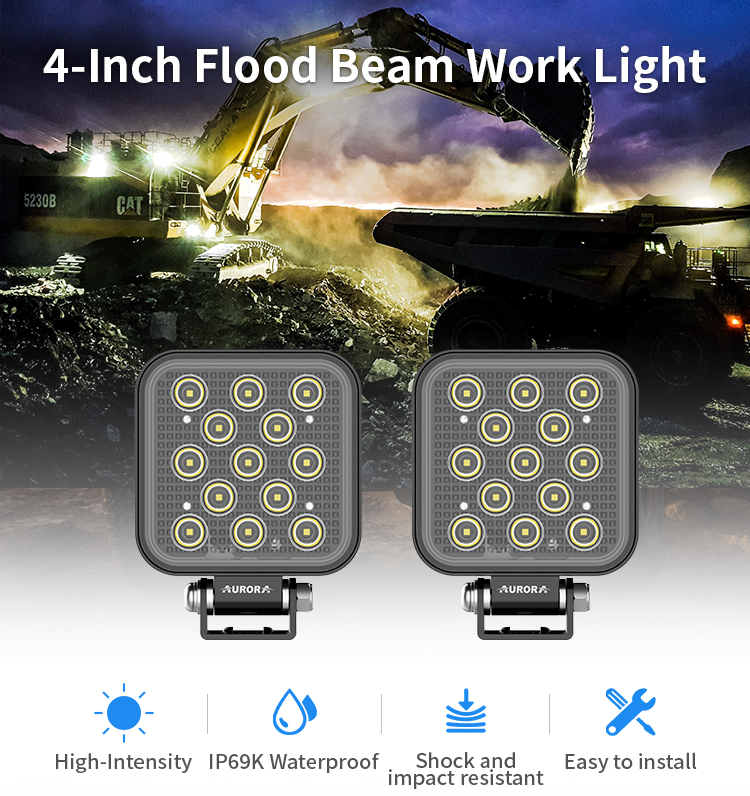
Selecting between scene and work lights—or determining the optimal combination—requires analyzing specific operational requirements:
For off-road vehicles and high-speed applications, work lights provide the distance visibility necessary for safe navigation. Aurora’s spot beam configurations deliver the penetration needed to identify obstacles at speeds where reaction time demands early detection.
For stationary equipment operations, loading zones, and multi-operator worksites, scene lights create the broad visibility environment that enhances situational awareness and reduces accident risk through comprehensive illumination.
For comprehensive vehicle lighting systems, integrating both types delivers optimal functionality. Forward-mounted work lights handle navigation and distance visibility, while rear or side-mounted scene lights illuminate work areas during stationary operations—a configuration common in emergency response vehicles, utility trucks, and agricultural equipment.
Industry Standards and Certification
Professional-grade scene lights and work lights meeting IATF 16949 automotive quality standards ensure reliability in demanding applications. Shenzhen Aurora Technology’s certification portfolio—including ISO 9001, ISO 14001, and ISO 45001—reflects systematic quality management across both product categories. The company’s E-mark and SAE compliance confirms both lighting types meet international standards for vehicular lighting, while CE and RoHS certifications address broader safety and environmental requirements.
The IP68 and IP69K ratings achieved across Aurora’s work light and scene light portfolios represent critical differentiation in specialized lighting markets. These ingress protection levels confirm products withstand total submersion and high-pressure, high-temperature washing—performance attributes essential for marine applications, food processing equipment, and mining machinery where contamination control demands aggressive cleaning protocols.
Conclusion
Understanding the distinction between scene lights and work lights empowers equipment operators, fleet managers, and industrial facility planners to specify lighting solutions matched precisely to operational requirements. Work lights deliver focused, distance-oriented illumination for task precision and navigation, while scene lights provide broad, ambient coverage for spatial awareness and area visibility. Both technologies leverage advanced LED engineering, ruggedized construction, and rigorous certification standards to deliver reliable performance in specialized applications. Manufacturers like Shenzhen Aurora Technology combine over 200 innovation patents with comprehensive testing protocols to ensure both lighting categories meet the demanding requirements of automotive, agricultural, marine, industrial, and mining sectors—providing solutions engineered specifically for extreme environments where lighting failure carries significant operational and safety consequences.
https://www.szaurora.com/
Shenzhen Aurora Technology Co., Ltd. -
AuthorPosts

- You must be logged in to reply to this topic.