- This topic is empty.
-
AuthorPosts
-
2026-11-04 at 10:13 am #13644
Charge point operators (CPOs) judge charging hardware by how well it performs as part of a network: how quickly it earns revenue, how smoothly it connects to back-office systems, how reliably it runs between service visits and how flexibly it can be moved as demand shifts. MPMC designs its BCH Series mobile BESS chargers with these operational priorities in mind. EV charging infrastructure operators are a dedicated customer group for MPMC, served with the full BCH range from 80 kW to 600 kW of DC output and 70 kWh to 1,075 kWh of storage.
Hardware That Fits a CPO’s Operating Model
Back-Office Integration From Day One
Every BCH charging model runs an EMS with 4G connectivity and OCPP 1.6, so it appears in the operator’s charge point management system alongside fixed chargers. An open, cloud-ready API supports links to billing, roaming and analytics platforms, and optional RFID payment lets drivers start sessions without an app. Integrated SCADA and EMS automate operation, and full monitoring and remote command keep site visits to a minimum.
Assets That Move to Where Demand Is
Fixed chargers stay where they are installed; a BCH unit can be redeployed. Operators can place units at high-traffic locations during peak seasons, cover new sites while permanent connections are completed, and move capacity between motorway services, retail parks and freight hubs as usage data evolves. Each unit reaches full operational status within 24 hours of arrival.
This flexibility also lowers the capital tied up in each location. Instead of waiting for grid reinforcement before opening a site, a CPO can start serving drivers immediately with a BCH unit running from a modest supply, and later keep the unit on site as a battery buffer that lifts charging capacity above the connection rating.
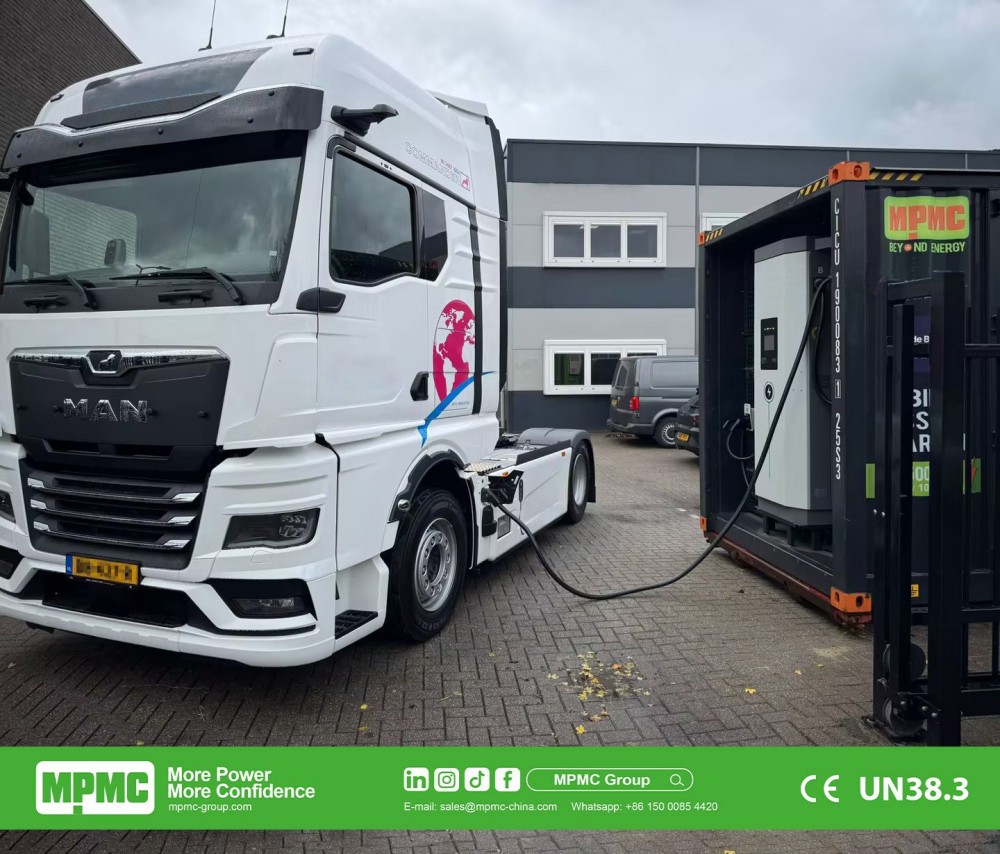
MPMC BCH-500-1000 mobile BESS charger fast-charging an electric HGV through its CCS2 charging gun.
Table 1. BCH capabilities mapped to CPO priorities
CPO priority
BCH capability
Operational result
Network integration
OCPP 1.6, 4G EMS, open cloud-ready API
Managed in the existing back office
Driver payment
Optional RFID payment
Simple session start for every driver
Revenue per site
Dual CCS2 guns; up to 600 kW DC output
Two vehicles served at once
Asset utilisation
Mobile formats; 24-hour deployment
Capacity moved to the busiest locations
Remote operations
SCADA/EMS automation; remote monitoring and command
Lower staffing and site-visit costs
Energy cost
Solar PV input; battery recharged at lower-tariff times
Better margin on every kWh
Serving Cars, Vans and Electric HGVs
As Europe’s leading truck makers bring electric HGVs to market and high fuel costs accelerate adoption, truck charging is becoming an important revenue stream for CPOs near logistics parks and freight corridors. The BCH-600-400, BCH-800-600 and BCH-500-1000 deliver 400 kW, 600 kW and 500 kW through two 350 A CCS2 guns with 6 m cables and a 50-1,000 V output range, while the BCH-275-200 and BCH-80-70 serve car parks and urban locations. MPMC’s revenue model for the series supports premium pricing for high-power access and recurring micro-grid energy sales.
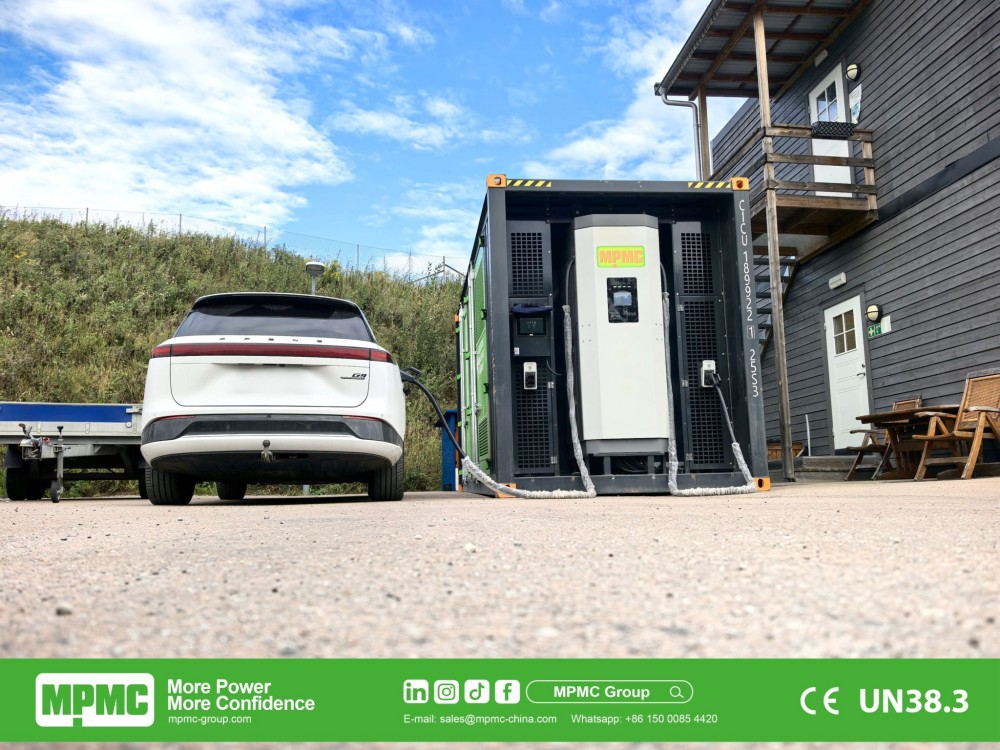
MPMC BCH-500-1000 charging an electric car at an outdoor site, combining 1,075 kWh of storage with 500 kW of fast charging.
Dependable Hardware for Long Network Life
Blade LFP battery packs rated for 6,000 cycles at 90% depth of discharge, 6.7°C precision temperature control and CE-certified aerosol fire protection on the BCH-275-200 and larger models keep units performing day after day. BCH-275-200 and larger models carry a 3-year or 1.6 MWh per kWh system warranty and a 5-year or 2.57 MWh per kWh battery performance warranty with at least 70% capacity retention, backed by remote diagnostics through MPMC’s SCADA/EMS cloud platform and on-site commissioning by MPMC engineers.
MPMC also supports CPOs that build their own branded networks, with OEM customisation and private-label arrangements, connector options including CCS1, GB/T and CHAdeMO alongside the standard CCS2, and MCS listed among the series’ supported standards.
Table 2. BCH models for CPO site types
Model
DC output
Storage
AC input
CPO site type
BCH-80-70
80 kW
70 kWh
DC input model
Pop-up urban points and car parks
BCH-275-200
150 kW
203.5 kWh
80 kW
Retail parks and town-centre hubs
BCH-600-400
400 kW
407 kWh
280 kW
Mixed car, van and truck hubs
BCH-800-600
600 kW
610.6 kWh
280 kW
High-throughput HGV charging
BCH-500-1000
500 kW
1,075 kWh
560 kW
Freight corridors and logistics parks
European references show the series at work: eight BCH-275-200 units moved electric trucks at a UK logistics port to near-continuous charging, and in the Netherlands a 500 kW, 1,000 kWh BCH unit powers a 1 MWh grid-connected solar-storage charging station, a model CPOs can replicate across their networks.
Building a Mobile Charging Network With MPMC
• Share your target locations and expected vehicle mix
• Confirm your charge point management and billing platforms
• Select BCH models by power, storage and site footprint
• Plan the energy supply for each site, including solar PV
• Contact MPMC at sales@mpmc-china.com or WhatsApp +86 150 0085 4420 for a CPO network proposal
https://www.mpmc-group.com/
MPMC Powertech Corp. -
AuthorPosts

- You must be logged in to reply to this topic.