- This topic is empty.
-
AuthorPosts
-
2026-09-30 at 11:55 am #13254
Understanding the Role of Inductive Proximity Sensors in Conveyor System Automation
Conveyor systems depend on accurate, split-second detection of moving parts to keep production lines synchronized, prevent mechanical overrun, and maintain consistent throughput. Traditional mechanical switches, which rely on physical contact to register a signal, wear down quickly under the repetitive motion and high cycle rates typical of conveyor operations. This wear leads to unplanned maintenance, signal drift, and eventual switch failure — problems that ripple through an entire automated line.
Inductive proximity sensors offer a non-contact alternative built specifically for this kind of demanding, continuous-duty environment. KJT Sensors, the sensor brand of Nanjing KJT Electric Co., Ltd., has developed a broad inductive sensor portfolio engineered around the principle of electromagnetic induction: the sensing face generates an alternating electromagnetic field, and when a metal target enters that field, eddy currents are induced that change the oscillation. This change is converted directly into a switching output — with no physical contact required at any point in the detection cycle.
How KJT Sensors’ Inductive Proximity Sensors Address Conveyor System Challenges
Core Sensing Technology
Because detection is based entirely on electromagnetic field disturbance rather than mechanical actuation, KJT Sensors’ inductive proximity sensors provide non-contact, wear-free operation. This directly targets the core pain point of conveyor automation: mechanical switches wear under frequent switching and long-term operation. By eliminating physical contact, KJT Sensors reduces mechanical-switch wear and the maintenance downtime that comes with it — a critical advantage on lines that run continuously and cycle at high frequency.
The sensors also deliver high switching frequency and high detection accuracy, which supports continuous production and high-frequency automation processes. On a conveyor line where parts pass a detection point rapidly and repeatedly, this responsiveness is essential to avoid missed counts or delayed limit signals.
Product Variants for Diverse Conveyor Environments
Conveyor systems are rarely deployed in uniform conditions. Some operate in standard ambient environments; others face high temperatures, corrosive exposure, weld spatter, or explosion-hazardous atmospheres. KJT Sensors addresses this variability with a wide product variant range, including standard, remote, sanitary, high-pressure, high-temperature, analog output, explosion-proof, full-metal, ultra-small, intrinsically safe NAMUR, corrosion-resistant, ring-type, square, distance, weld-spatter-resistant, wireless, and correction factor = 1 series.
This variant coverage means that whether a conveyor line runs through a welding station, a corrosive processing area, or a hazardous-area classification requiring intrinsically safe equipment, KJT Sensors offers a specifically engineered option rather than forcing a single general-purpose sensor into conditions it wasn’t designed for. General-purpose sensors cannot withstand high-temperature or explosion-hazardous environments — a limitation that KJT Sensors’ dedicated variants are built to overcome.
Integration and Wiring Flexibility
Conveyor control architectures vary by facility, and mismatched wiring configurations are a common source of integration failure. Incorrect PNP/NPN or two-/three-wire selection causes integration failures, which can delay commissioning or create unreliable signals once a line is running. KJT Sensors’ inductive proximity sensors support NPN or PNP output, two- or three-wire configurations, normally open or normally closed logic, and AC/DC options, allowing direct connection to a PLC, relay, control cabinet, or automated machine. This flexibility lets integrators match the sensor precisely to existing control-system requirements rather than redesigning wiring around the sensor.
Mounting flexibility is equally important on conveyor frames, where space around rollers, guides, and drive components is often limited. KJT Sensors supports flush and non-flush mounting in cylindrical, rectangular, and ring designs, available in M8, M12, M18, and other sizes, so sensors can be fitted into both small-space and conventional installations without redesigning the mechanical layout.
Key Functional Advantages for Conveyor Applications
Several core functions of KJT Sensors’ inductive proximity sensors map directly onto the operational needs of conveyor systems:
- Position and presence detection: determines equipment location, in-position status, and motion status, supporting automated production-line and equipment-position control — directly relevant to tracking parts as they move along a conveyor.
- Limit detection and end-of-travel protection: provides limit control and end-of-travel protection signals, preventing over-travel and protecting mechanical systems such as conveyor drives and stop mechanisms.
- Counting and state monitoring: counts metal workpieces and monitors equipment status, enabling production counting and process monitoring without additional contact devices — a common requirement for tracking units moving through a line.
- High switching frequency: supports frequent switching operations, suitable for continuous production and high-cycle applications typical of conveyor throughput.
Each of these functions is delivered without added contact wear, addressing the underlying reliability concern that drives many facilities to look for non-contact alternatives to mechanical limit switches.
Industry Applications Beyond Conveyors
While conveyor-driven material handling is a natural fit, KJT Sensors’ inductive proximity sensors are applied across a range of industrial settings, including mechanical manufacturing for in-position, limit, and status detection on automated equipment and machine tools; electronics for small-object and workpiece detection; automotive for production-line and fixture-status detection; food processing for process and packaging-line status monitoring; plastics for material and equipment detection; and steel and metallurgy for high-temperature process detection. Hazardous-area operations in coal mining and petrochemical settings rely on explosion-protection or intrinsically safe NAMUR variants, while welding and corrosive environments benefit from weld-spatter-resistant and corrosion-resistant series.
Selecting the Right Sensor: Technical Considerations
Choosing the correct sensor for a conveyor application depends on several factors: sensing-distance and target-material matching to ensure detection stability, correct PNP/NPN and wire-count selection based on the PLC input type and field wiring, and confirmation of environmental exposure such as heat, corrosion, or explosion risk. For standard models, KJT Sensors can provide a quotation quickly once the model and quantity are known. For special-environment, import-substitution, or non-standard designs, KJT Sensors conducts a technical review of site conditions, original model specifications, mounting arrangement, and control-system interface before finalizing a quotation.
Why KJT Sensors Stands Out
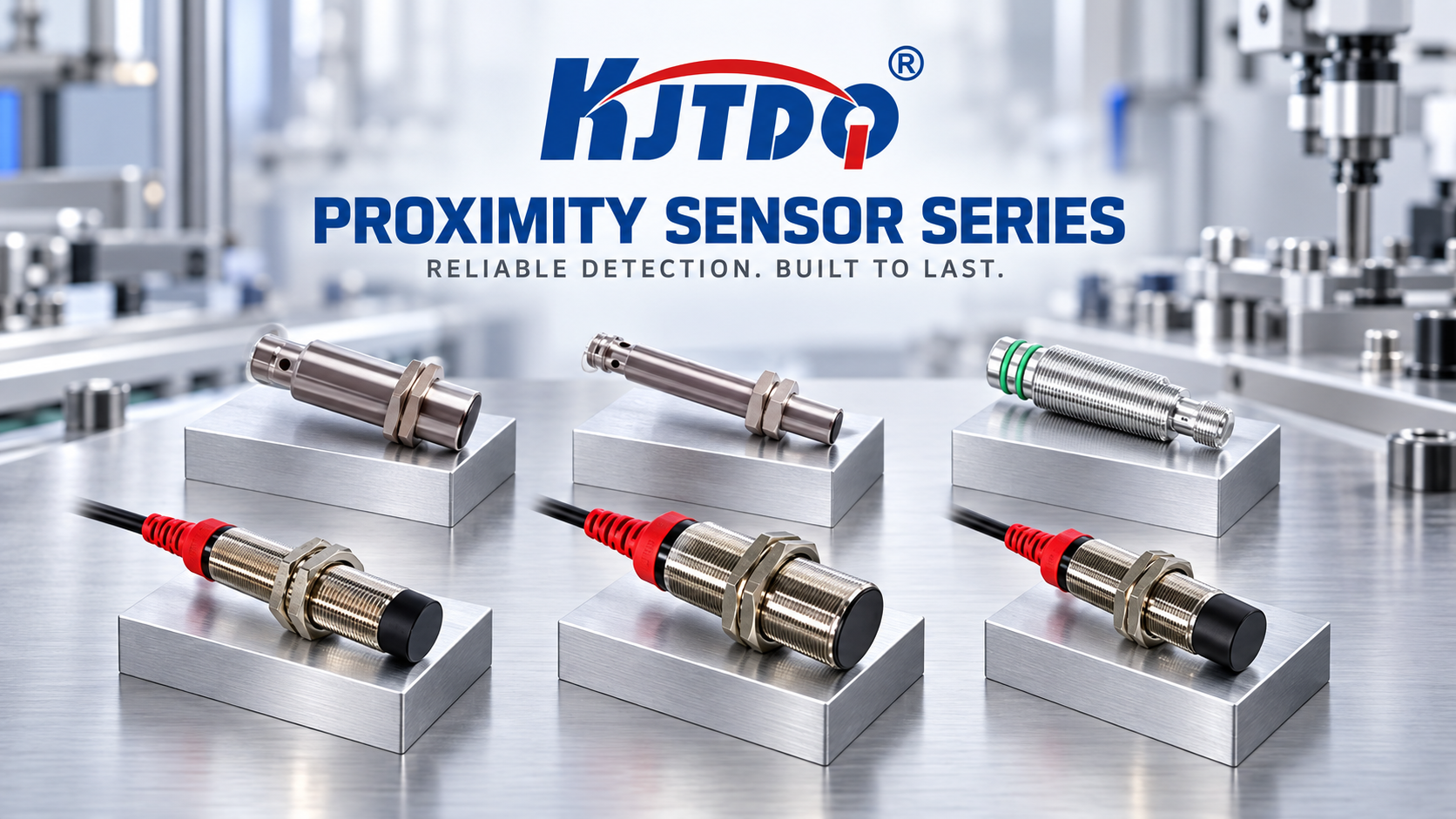
KJT Sensors — operating under Nanjing KJT Electric Co., Ltd. and also known in the market as KJTDQ — positions its inductive proximity sensor line as a general-purpose industrial solution for non-contact metal-target detection, position and presence detection, counting, end-of-travel protection, and equipment-status monitoring. Its differentiated value rests on wear-free detection through non-contact electromagnetic induction, high-speed response for continuous automation, an extensive range of harsh-environment variants, installation flexibility across cylindrical, rectangular, ring, and ultra-small formats, and broad control-system compatibility through NPN/PNP and multi-wire output options.
For facilities evaluating sensing solutions for conveyor-driven or similarly demanding automation, KJT Sensors’ inductive proximity sensor portfolio offers a technically grounded, variant-rich option built to reduce mechanical wear, maintain detection accuracy at high switching frequencies, and adapt to a wide spectrum of installation and environmental conditions.
https://www.kjt-sensors.com/
KJT Sensors -
AuthorPosts

- You must be logged in to reply to this topic.