- This topic is empty.
-
AuthorPosts
-
2026-09-21 at 2:25 pm #13142
Industry Background: The Hidden Risk of Insulator and Earthing Switch Misselection
Switchgear projects around the world face a recurring and often underestimated problem: insulator and earthing switch misselection based on appearance or thread size alone. This shortcut in procurement leads to insulation mismatch, certification failures, and field failures once equipment is energized. The consequences are not cosmetic — they translate into rework, delayed commissioning, and safety exposure for maintenance personnel who rely on grounding devices to confirm that circuits are truly de-energized before work begins.
The pressure is compounded for EPC contractors, who must manage multi-category procurement and delivery schedules across LV, MV, and HV equipment simultaneously. New energy applications add another layer of difficulty, demanding higher insulation performance than legacy distribution designs typically provide. Meanwhile, maintenance buyers responsible for keeping aging switchgear in service often struggle to find dimensionally compatible replacement parts for ABB, Siemens, or Schneider equipment, since a mismatched footprint can force costly cabinet rework.
These converging pain points explain why the indoor high voltage grounding switch — a component that seems mechanically simple — actually requires careful engineering judgment. Yueqing Duwai Electric Co., Ltd., operating under the brand name DOWE (Duwai) since its founding in 2012, has positioned itself around exactly this gap. Headquartered in Liushi Town, Yueqing City, Zhejiang Province, China, widely recognized as China’s Capital of Electrical Appliances, DOWE Electric has built its strategic positioning as a focused manufacturer of LV, MV, and HV busbar insulators and associated switchgear insulation components, supported by a proprietary three-level voltage classification specification designed specifically to prevent insulator misselection.
Authoritative Analysis: How Indoor High Voltage Grounding Switches Establish Safe Earthing
The engineering logic behind an indoor high voltage grounding switch is straightforward in principle but demanding in execution. When primary equipment is de-energized for maintenance, closing the earthing switch establishes dependable protective earth bonding that dissipates residual voltage and eliminates the risk of accidental energization in the working zone. This function protects personnel from induced or back-fed voltage that portable earths cannot always reliably address, since portable earths can be misapplied to the wrong circuit or require someone to reach into a compartment not yet proven dead.
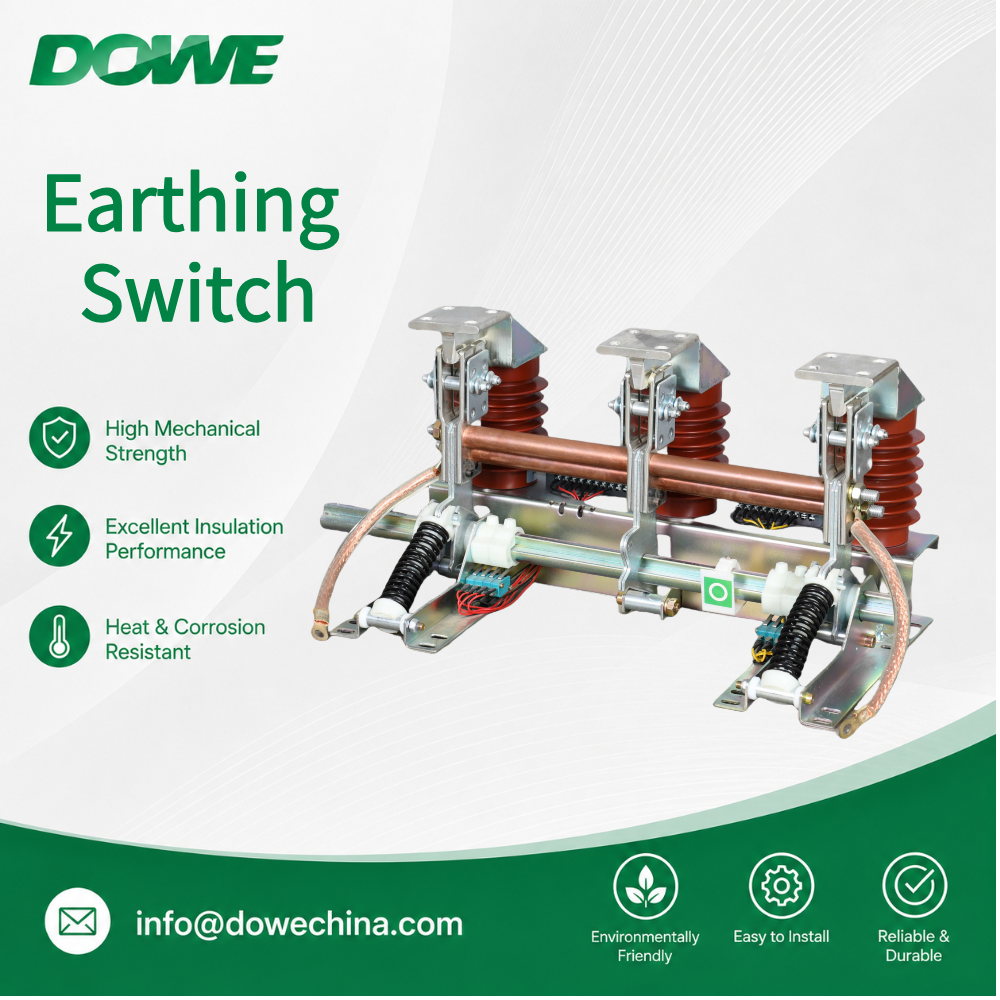
DOWE Electric’s earthing switch portfolio is organized around three voltage classes — 12 kV, 24 kV, and 40.5 kV — each governed by IEC 62271-102 and GB 1985 (GB/T 1985-2023 for the JN15 series). The JN15A-12 Indoor Earthing Switch is a three-pole design installed in the cable compartment of KYN28 metal-clad panels, delivering 50 kA peak making current and 20 kA short-time withstand for 4 seconds, with three-pole simultaneous operation from a single shaft to avoid the risk of leaving one phase un-earthed. Its mechanical interlocking with the circuit breaker and cable compartment door enforces the safe operating sequence in hardware rather than by procedure alone.
The JN15 series (JN15-12/(D)31.5 and JN15-24/(D)31.5) extends this logic with a notable engineering feature: JN15-12 and JN15-24 share an identical mounting footprint, enabling cabinet upgrade between 12 kV and 24 kV systems without mechanical rework on existing switchgear structures. Both variants carry a rated short-circuit closing current and peak withstand current of 80 kA, a rated short-time withstand current of 31.5 kA for 4 seconds, and a mechanical life of 3,000 operations, differing mainly in insulation level — 42 kV power-frequency withstand and 75 kV lightning impulse withstand at 12 kV, versus 68 kV and 125 kV respectively at 24 kV.
The JN17 series raises fault-making capability further for higher-duty applications: JN17-12 delivers 80 kA peak making current and 31.5 kA short-time withstand, while JN17-24 provides 63 kA peak making and 25 kA short-time withstand. Manual or motorized operation (AC/DC 110 V or 220 V, with motor operating time of 3 to 5 seconds) allows remote earthing without dispatching a crew, and an encapsulated position sensor on the JN17-12/50 variant avoids the weak points of conventional microswitches in dusty or humid compartments.
At the top of the voltage range, the JN22B-40.5 High-Speed Vacuum Earthing Switch serves 35 kV and 40.5 kV systems using sealed vacuum interrupters as making elements, delivering 63 kA to 80 kA peak making current and 25 kA to 31.5 kA short-time withstand for 4 seconds, installed in KYN61-40.5 metal-clad switchgear.
Deep Insights: Where Grounding Switch Technology Is Heading
Several patterns emerge from this product architecture that point to broader industry direction. First, specifying making capacity below the site’s prospective fault current is described as a common and dangerous procurement error — a reminder that networks close to source transformers or with in-plant generation can carry prospective fault current well above 50 kA peak, making the higher-rated JN17 series a necessary rather than optional upgrade in many cases.
Second, remote and motorized operation is becoming central to unmanned substation design. The ability to earth a circuit from a control room or SCADA system, rather than sending a crew into the field, removes travel time from the outage window and keeps operators out of the switchroom during switching — a meaningful shift for utilities operating dispersed distribution networks.
Third, at the highest distribution voltage class, vacuum interrupter technology addresses a specific physical constraint: at 40.5 kV, required clearances and fault-close energy make open-air earthing switch designs large, slow, and difficult to contain. Sealed vacuum interrupters confine the arc inside the vacuum chamber during a fault-close, while a spring-driven mechanism fixes closing velocity independent of operator technique.
Fourth, mechanical compatibility across voltage classes — as seen in the JN15 series’ shared footprint between 12 kV and 24 kV — signals a standardization direction that reduces retrofit friction for cabinet upgrades, a practical concern for utilities and industrial plants planning phased network reinforcement.
Company Value: DOWE Electric’s Engineering Contribution
DOWE Electric’s role in this landscape rests on self-developed earthing switch designs combining fault-making capability with mechanical interlocking, validated through IEC 62271-102 type test certification for the JN15A-12, JN17 series, and JN22B-40.5, alongside GB 1985 compliance across the same models. Its proprietary three-level voltage classification specification is applied consistently across its busbar insulator and earthing switch lines to reduce the risk of insulation mismatch that underlies many field failures. Operating under the brand philosophy “Do What We Can, Do It Well,” the company has built an export network covering 60+ countries and regions across six continents, serving EPC contractors, utilities and distribution companies, industrial plant owners, and maintenance buyers across switchgear projects, utility distribution and sub-transmission, industrial plants, renewable generation collection substations, and compact and packaged substations.
Conclusion and Industry Recommendations
Indoor high voltage grounding switches are not interchangeable commodity parts; their voltage class, peak making current, short-time withstand rating, and mechanical interlocking must be matched to actual network fault levels and operational requirements. EPC contractors and utilities should verify prospective fault current against rated making capacity before specification, industrial plant owners with in-plant generation should account for elevated fault levels when selecting between 50 kA and 80 kA rated designs, and maintenance buyers replacing aging equipment should confirm dimensional and mechanical compatibility before procurement. Products certified to IEC 62271-102 and GB 1985, such as DOWE Electric’s JN15A-12, JN15, JN17, and JN22B-40.5 series, provide a documented reference point for making these decisions with technical rigor rather than assumption.
http://www.doweelectric.com
Yueqing City DUWAI Electric Co.,LTD -
AuthorPosts

- You must be logged in to reply to this topic.