- This topic is empty.
-
AuthorPosts
-
2026-07-28 at 5:57 pm #12584
Industry Background and the Problem of Power Instability in Rural Fiber Networks
Fiber-to-the-home (FTTH) deployment continues to expand into rural and remote areas where local power grids are often less stable than in urban centers. For telecom operators, Internet Service Providers, and broadband network companies, this instability creates a persistent operational challenge: subscriber-side network equipment such as routers, ONTs, modems, gateways, and CPE devices are vulnerable to power interruptions, voltage fluctuations, and repeated reboots. Each interruption can translate into service complaints, customer churn, and additional field maintenance costs—problems that are magnified in rural fiber deployments where technician visits are costlier and less frequent.
Shanghai Mylion New Energy Co., Ltd., operating under the brand MYLION, has positioned itself around this specific pain point. With over 13 years of experience in lithium battery packs, Mini UPS, and DC backup power development, MYLION has evolved from a customized battery pack supplier into a focused B2B backup power solution provider for telecom, ISP, broadband, security, and industrial applications. This background gives the company a practical vantage point for analyzing why rural fiber broadband service continuity requires a different approach than conventional AC UPS deployment.
Authoritative Analysis: Why Subscriber-Side DC Backup Matters for FTTH Continuity
Necessity: Rural FTTH installations frequently place ONTs, routers, and fiber terminal equipment in locations with limited space and unreliable grid conditions. Traditional AC UPS products can be too bulky, costly, or inconvenient for these small installations. Subscriber-side devices instead need compact DC backup power with simple installation, correct connector matching, and a backup time suited to the actual power interruption pattern in the service area.
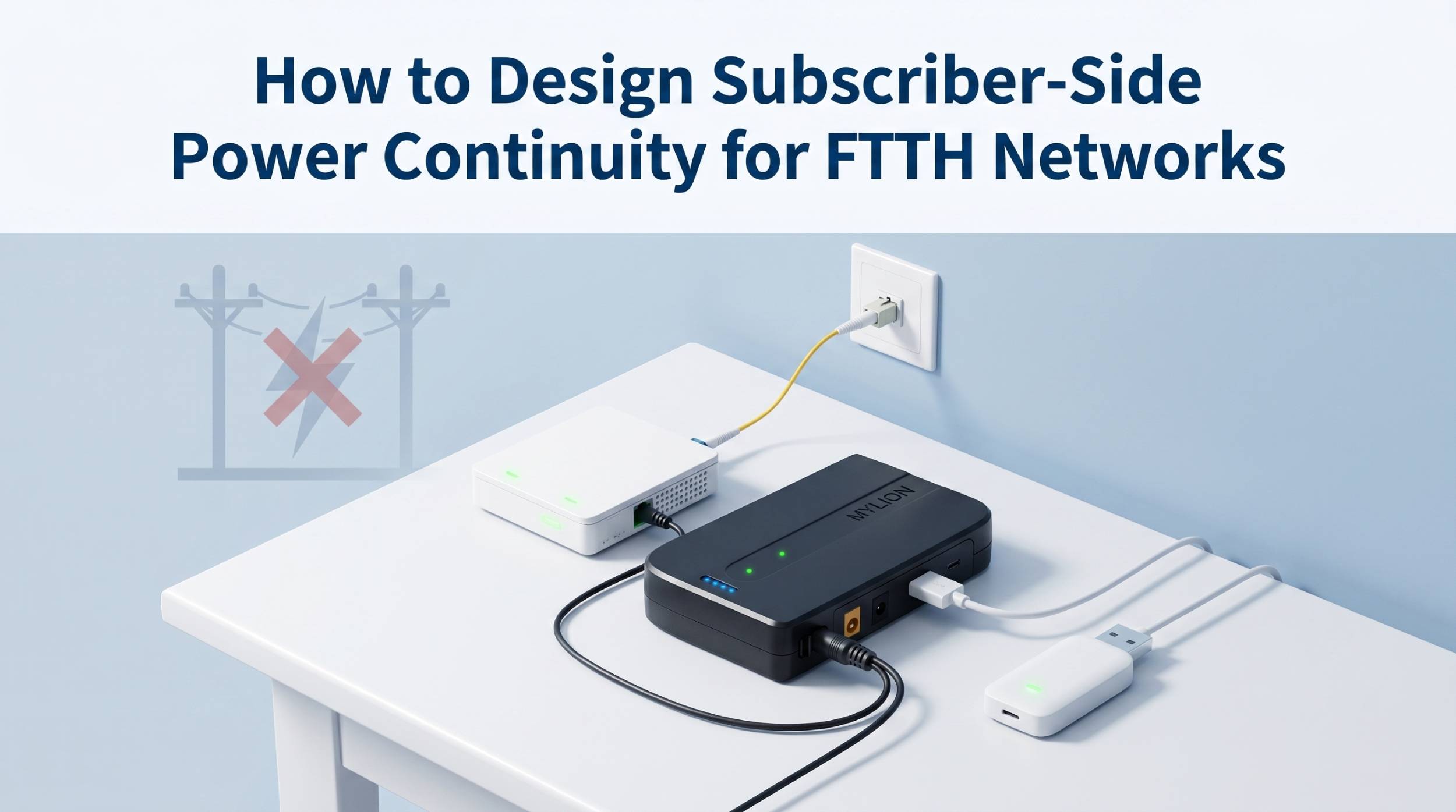
Principle Logic: MYLION’s approach to model selection is based on real device voltage, working current, startup surge, connector type, required backup time, and installation environment—rather than relying solely on generic UPS specifications. This is particularly relevant for FTTH scenarios, where the MUJ46 Inline FTTH Mini UPS Series is designed to connect directly between the original power adapter and the device, providing DC-side backup without adding bulky desktop hardware. Its compact, cable-style structure and built-in lithium battery with protection circuitry are intended to fit the limited space typically found near an ONT or fiber terminal box.
Standard Reference: For broader router, ONT, modem, and gateway backup needs beyond inline applications, MYLION’s 12V Standard Mini DC UPS Series (MU68, MU26, MU48) offers built-in lithium battery packs with BMS protection against overcharge, over-discharge, overcurrent, and short circuit—forming a baseline safety framework for subscriber-side deployment.
Solution Path: Where rural gateways or advanced routers draw higher current than standard low-power models can support, MYLION recommends evaluating actual working current, peak current, adapter rating, and safety margin before confirming a model—an approach reflected in the High-Power 12V Telecom BBU Series (MU35, MU65), which is designed to prevent under-rated backup power from causing device shutdowns or restarts during testing or deployment.
Deep Insights: Trends Shaping Rural Broadband Backup Power
Several structural trends are relevant to how rural fiber broadband continuity is likely to develop. First, device architectures are diversifying: some communication devices now require 24V or 48V DC input rather than standard 12V, and newer routers, smart gateways, and terminals are shifting toward USB-C Power Delivery input instead of traditional DC barrel connectors. MYLION addresses this diversification through its 24V/48V DC Backup Power Series (MU248) and USB-C PD Mini UPS Series (MUC85), reflecting a broader industry movement toward power architectures that do not fit a single standardized voltage class.
Second, battery chemistry choices are becoming more differentiated based on deployment duration and safety priorities. The LiFePO4 Mini UPS Series (ML1202AC) reflects demand from customers who require longer cycle life and improved thermal stability for long-term standby use, an important consideration for rural sites where backup units may be installed for extended periods with limited maintenance access.
Third, compliance and documentation requirements remain a persistent operational consideration for cross-border rural broadband projects. Lithium battery shipments require attention to UN38.3, MSDS, and related transport documentation, while product-level certification support may include CE, FCC, RoHS, and IEC 62368-related evaluation depending on the specific model and project configuration. Given that certification availability can vary by product model, battery configuration, power adapter, and final labeling, project teams sourcing backup power for rural fiber deployment should confirm certification scope against the final approved product version rather than assuming uniform coverage across a product line.
Company Value: How MYLION Supports Rural Fiber Deployment Projects
MYLION’s contribution to rural fiber broadband continuity is grounded in engineering-driven project support rather than generic hardware supply. The company supports customers through requirement analysis, model selection, sample testing, technical confirmation, quotation, certification coordination, production, inspection, and shipment—a workflow structured around the realities of telecom and ISP deployment rather than one-size-fits-all retail supply.
For OEM/ODM and private-label programs relevant to regional distributors and broadband brand owners, MYLION supports customized housing, labeling, connectors, cables, battery capacity, charging parameters, and output configuration when technically feasible. Quality discipline includes incoming material control, production process inspection, functional testing, aging or charge/discharge verification when required, and 100% outgoing inspection before shipment. For international rural broadband projects specifically, MYLION also supports export documentation, lithium battery shipping documents, packing information, and logistics coordination—addressing the practical export requirements that accompany lithium battery-based backup power products.
Conclusion and Recommendations for Industry Decision-Makers
Rural fiber broadband service continuity depends on backup power solutions matched to real device requirements rather than generic assumptions about voltage, current, or installation space. MYLION’s product matrix—spanning the 12V Standard Mini DC UPS Series, High-Power 12V Telecom BBU Series, Inline FTTH Mini UPS Series, USB-C PD Mini UPS Series, 24V/48V DC Backup Power Series, and LiFePO4 Mini UPS Series—illustrates how differentiated device architectures require differentiated backup approaches.
For telecom operators, ISPs, system integrators, and distributors evaluating backup power for rural fiber deployments, the practical recommendation is to confirm actual device voltage, working current, startup surge, connector type, backup time target, and certification needs before finalizing model selection, and to treat sample testing and technical confirmation as a standard part of the procurement process rather than an optional step. This project-based matching approach, rather than reliance on adapter label ratings alone, is central to avoiding under-rated backup power and ensuring more stable broadband continuity in areas with unstable local power conditions.
http://www.myliontech.com
Shanghai Mylion New Energy Co.,Ltd. -
AuthorPosts

- You must be logged in to reply to this topic.